End-of-Season

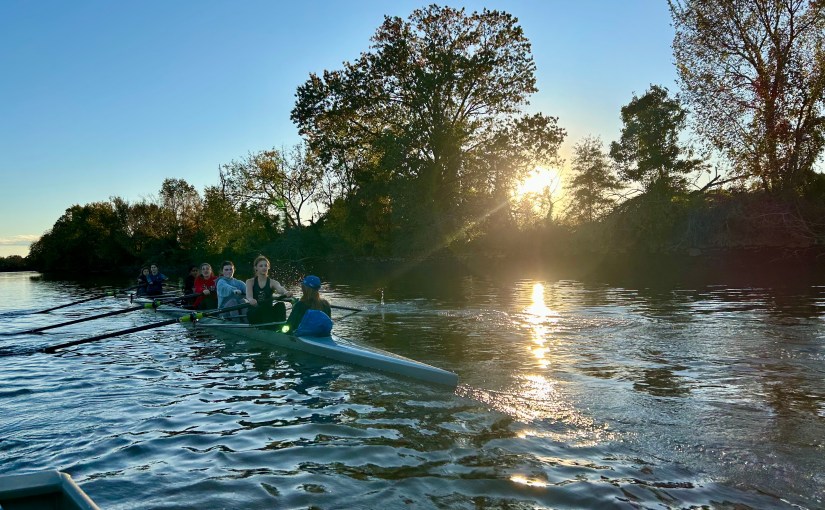
The end of rowing season always brings feelings of relief and melancholy: so many days, so many hours of rowing, driving to the boathouse, planning workouts, carrying boats down to the dock, washing shells after practice, breaking down the motor launch, chatting at the park with others who share a love of the best sport in the world. I miss the exhaustion already, and don’t know how to fill my extra time.


I finished the Sunday crossword puzzle two weeks in a row, and I’ve learned a couple of new tunes on my recorder, ready to join the Celtic Ensemble again. I’m loving my new crime thriller audiobook (Louise Penny’s Inspector Gamache is so much fun). My son and I went shopping for winter coats together. We had Thanksgiving at a friend’s. My life is full. Yet I find myself researching winter workouts when I should be planning next week’s lessons for school.


I never thought I’d get pulled back into coaching teens again, but that’s exactly what’s happened. I love it and dread it at the same time. I love teaching new rowers the protocols and technique. I love watching young people get excited about doing hard physical work for the first time, especially when they thought they couldn’t. I love the playfulness they bring to the team, even when my reprimands about horseplay brought the wrath of parents.


It’s a rebuilding year with a small high school team. My job is to keep it fun, to teach the sport, and bring everyone back in the spring to start all over again. And bring a friend.


Seasonal transition periods usually make me more reflective, and this one is no different. Should I retire and become head coach again? For real? Should I finally downsize and move out of this large home? My older son recently got engaged. This would be a perfect grandmother house, if that’s in the future. I can put off that decision for now. I still have a rewarding, full-time teaching job. I believe I still make a difference.


Fellow masters rowers have started the Holiday Erg Challenge, a Concept 2 virtual rowing regatta, where the goal is to row 100K between Thanksgiving and Christmas. This is a regatta for people who don’t embrace the liminal space of transition like I do. They gather in the 28-degree dawn at the boathouse, ergs lined up in the darkness. They’re rowing 10K on the machines every day. I planned to join them, but sleeping in until sunrise and home-brewed coffee in my pajamas just called too loudly this year.


Tomorrow it’s December and we start the high school winter workouts three days a week. I’ve enjoyed my down time, but it’s time to embrace the crazy-busy again.

Mixed Masters 8+

Head of the Occoquan Regatta

Steering Through the Muck – A Rowing Story

Two days after the presidential election, I went rowing on the Anacostia River in Washington DC. Our season usually ends after the first weekend in November, so it was a last-hurrah kind of moment before the weather grew too cold. A poignancy more pronounced by my extreme dismay over the election outcome. 

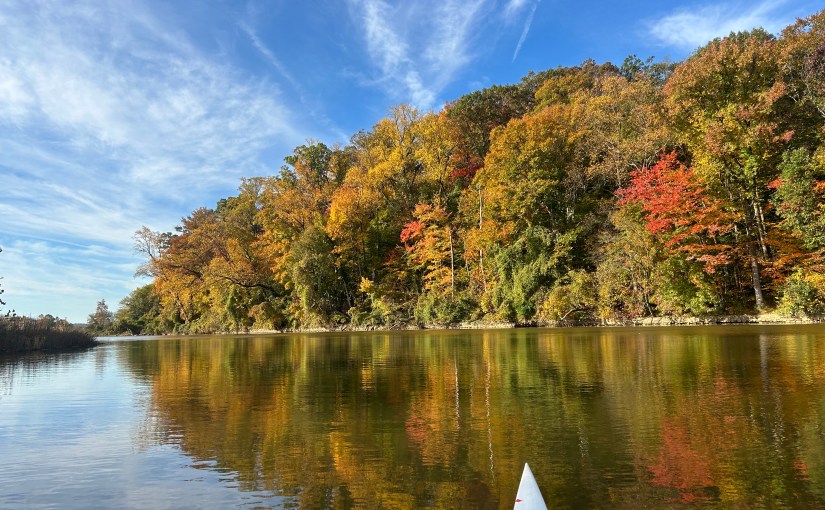
Trees along the river glowed red, gold, and various shades of green. A perfect blue sky reflected like a postcard image in the water. I rowed downriver backwards, two ten-foot oars sticking out on either side of the narrow racing shell, and considered how lucky I was to have this sport, this river, this scenic beauty, especially on a day when, like so many others, I desperately needed solace and release. 

Near the docks, a dredging barge lay in wait, ready to suck the sludge from the bottom of the river so the Bladensburg Waterfront Park harbor could still host the large Anacostia Watershed Society pontoon boats, their fleet of canoes and kayaks, and the seven different private rowing clubs that launch from the park. 

Muckraking. They were literally muckraking. 

The dredging crews have to wait until the end of the season, when high school rowing teams are finished for the year. And before river creatures begin their winter hibernation.

A transitional time in nature and a transitional time in our country.

I turned to starboard and steered clear of the enormous underwater boom marked by large orange buoys. Further downriver, I navigated through a series of Surface Water Passive Samplers that suddenly appeared (I only learned later that they were placed in the river by the Department of Energy and Environment for a multi-year being undertaken by the District to mitigate toxic sediments (https://restoretheanacostiariver.com/). Great work, but a huge hazard for boaters if improperly marked.

At the river bend just upstream from the National Arboretum, I gasped in awe. Such spectacular beauty could not be captured; I pulled my phone from its ziplock pouch to snap a photo anyway. The wall of colorful trees against a bright blue sky soothed my eyes. The rhythm of rowing calmed my nerves. They may have won the election, but they can’t take this away from me, I thought.

“How far are you rowing?” I asked Bob, who often rows a single at the same time as me. We’re the Odd Timers, a rag-tag group that goes out whenever we can get a few people together. 

“Until I forget the worries of today and prepare for the worries of tomorrow.” 

I probably need to keep rowing for four more years, I thought.

I turned around just above the Langston Golf Course and headed back to the dock. The dredging barge was still there, clearing the channel to make it navigable for the rest of the year. Then my oar hit a rebar post sticking up with no buoy or flag to indicate a hazard. It could have easily pierced my rowing shell.

I’ve been thinking about all the obstacles and chaos coming our way starting January 20. The president-elect promised to “drain the swamp.” But when you actually remove the mud, it clears the way, opens new channels, and allows water to flow smoothly downstream.

I predict a lot of metaphoric dredging booms and unmarked hazards in our future. We will all have to navigate through the muck of this new administration. When their time is over, the muckrakers will clear the path and natural beauty will prevail. Both on the river and in our country.

Repetitive Movement

John is in the woods near my house chopping fallen trees. His forceful grunts echo up the ravine as he slams down on logs over and over and over again. 

My nephew paces the floor when he visits, around and around and around. 

My son plays video games from the moment he wakes up, clicking, tapping, and exclaiming. 

Repetitive physical movements have a calming effect that can reduce our fear and anxiety over things we can’t control. Like the uncertainty and chaos of the entire past 20 months. 

Writer Annie Dillard observed that “how we spend our days is how we spend our lives.”

If that’s the case, I need to examine how I spend my days.

During quarantine, I walked outside twice a day and wrote short stories, poetry, and personal essays. After Zoom classes, I played my recorder behind closed doors. In warm weather, I rowed on the Anacostia and Potomac rivers. I built a fire in the fire pit and sat outside with friends and neighbors. 

These routines got me through the worst of the pandemic.

I’m holding on to them like a prayer to get me into next year, because who knows what 2022 will bring? 

Beaver attack!

Two days after the full moon of November, I was attacked by a wild beaver in the middle of the Anacostia River. It swam toward me as I fumbled to take out my phone and capture it on video. So cute! I’d just seen a flock of turkeys, so I thought it was a good wildlife day. Until it swam aggressively under my rigger, leaped over the gunwale, and chomped down on my right hip. 

This is not the only thing in my life to go completely wrong this fall, but it’s certainly the most extraordinary. I could never have predicted, for example, that my husband of 31 years would decide to retire and move to Maine on the same day, leaving me with a developmentally disabled son to manage alone. The irrational behavior of my siblings before and after my mother died hurt me more than I can admit. But rowing has always been my place of refuge, recreation, and relaxation. The river is my antidote for all that ails me.

Some people would take an attack like this as a sign to stop rowing all together. The cold weather usually forces us off the river from mid-November until late February. However, a crisp 50-degree, sunny afternoon lured six of us to launch our singles and head out together. I’m a seasoned rower, a coach, and a strong advocate of safety precautions. In fact, I’d just reviewed with Anthony how to avoid hypothermia if he flipped his boat and fell into the water.

Sarah caught up with me just south of the New York Avenue bridge while we waited for the others. She said she’d hit a beaver with her boat! Minutes later, Ben confirmed that he’d seen a beaver, too; maybe it was the same one. Rowers out of Bladensburg Waterfront Park are more accustomed to Great Blue herons, osprey, kingfishers, geese, and the occasional bald eagle. It’s unusual to see a beaver in the river but November is the time of year that they are busiest, preparing their lodges for winter. Why would it swim in front of a rowing shell?

I turned around first to head back to the dock, rowing pretty much ahead of everyone else, when I heard a big splash and looked over. Nothing. A few minutes later, a beaver emerged just off my stern. So exciting! I thought. I hustled to take my cell phone out. The thing started moving toward me at an alarming speed! Maybe it was looking for food? It had a large, open, pink sore on its head. 

In survival scenarios, victims often find a strength that they didn’t know they possessed. I screamed at the top of my lungs, grabbed the beaver’s front paw, and beat it on the head with one hand while desperately holding the oar handles steady to keep from tipping into the river. My waterproof bag was open, and everything would have tumbled into the river. Water splashed up onto my lap, soaking me from knee to waist in frigid water. 

I will never forget those orangey-brown incisors coming at me! 

The beaver would not let go. Martin and the others appeared around the bend, but they were too far away to hear me. Dang! I continued scream-shouting and hitting the beaver on the head. It finally let go. I slapped my blade on the water to warn it away. It looked at me, like it wanted more, so I rowed like it was the last 250 meters of a sprint race all the way back to the dock. 

What I’ve learned about myself from this incident is that I am resilient and determined. When faced with unprecedented challenges, I will fight to stay upright. This lesson applies to my personal life as well. Some days feel like I’m rowing upstream against invisible enemies. Other days, I can stop to enjoy the beauty surrounding me.

I will never stop rowing. 

Weather warning: magical morning

After torrential rains and coastal flood alerts, it was not at all clear that I’d be able to row on Saturday morning. But I got up before dawn any way, and dressed in my tights and performance tee — the one that stays warm when it’s wet. I drove out to the waterfront in the dark drizzle, easily found a parking spot, and watched the sun rise from the Bladensburg boat house.

A few other rowers were already on the dock sweeping off goose droppings and pushing heavy debris away from the launch area. Coaches had pulled their motor boats onto the dock the night before so they wouldn’t float away in the storm. The strong current washed the logs easily downstream. As the sun rose, the rain stopped, and instead of the usual mud banks, the high, flat water of the upper Anacostia River stretched out wide across from me. High tide. Cool air. Perfect rowing conditions.

My stress level started to fall once I shoved off — it had been a crazy week. At school, several fights had broken out, and a medical emergency sent us into a shelter-in-place. Rumors were flying that someone had been stabbed (not true, thank god). Every day, a different student was crying at their desk. Senior essays were overdue, college application deadlines loomed, and Halloween hijinks forced school administrators into high alert. 🚨 My own anxiety about paying utilities and the mortgage on time spiked my cortisol levels.

The upper Anacostia is so different than the lower part of the river – with the stadium, Navy Yard, several yacht clubs, and industrial-building landmarks – that fellow rowers at Capital Rowing Club have named us Narnia (after the children’s fantasy). In fact, on that very morning, CRC was hosting their annual Narnia Chase regatta downriver.

What most people don’t know is that our section of the Anacostia River is a lush greenway, full of wildlife and unexpected natural beauty. Normally I row past Kenilworth Aquatic Gardens, the National Arboretum, and down past Kingman Island. Osprey flying with fish in their talons, turtles sunning on a log, great white egrets, black cormorants with outstretched wings that look like little Draculas, noisy geese, beavers, and the occasional bald eagle pop into view.

So when Sue suggested we head upstream, it didn’t take much to convince me. Even though I’ve been rowing out of Bladensburg Waterfront Park for 15 years, I’d never rowed upstream. Here’s why: that part of the river, even at high tide, is not usually navigable due to the mud and silt that washes down from the streams further north. The mud is so bad that once every couple of years, the Army Corps of Engineers has to dredge near the docks so that we can continue accessing the river there.

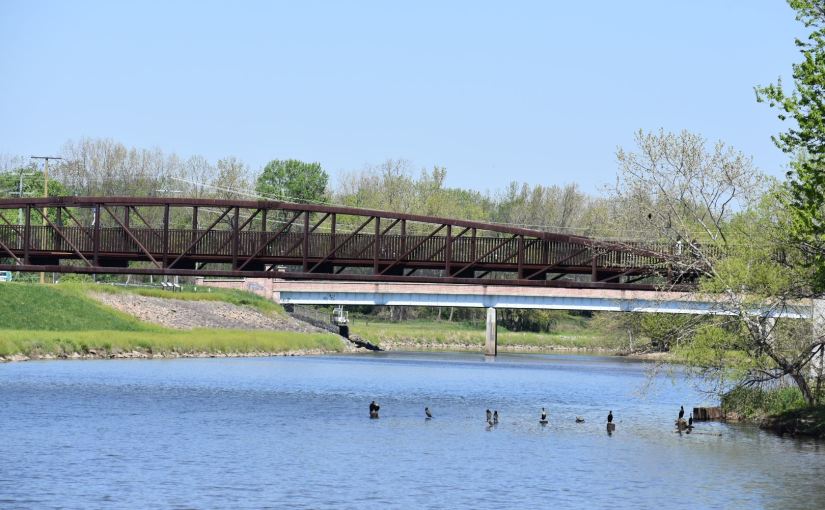
We rowed under the footbridge that normally signals danger, and kept rowing north to the confluence of the Northeast Branch Stream and the Northwest Branch Stream — the headwaters of the Anacostia. Only ducks and geese witnessed our historic adventure. The calm quiet juxtaposed against the fierce current and the surprisingly warm sun created a magical effect. Who needs fiction when such an extraordinary moment can transform us? We turned around at the Route 1 bridge, and I unsealed the plastic case around my phone camera to record the event. I smiled with child-like delight all the way home.

What I know about the Anacostia River

What I know about the Anacostia is what others will find out soon, when the Anacostia Riverwalk Trail bike path opens in about a month. This DDOT video shows how the last segment of the trail moves north, up through Anacostia Park, Kenilworth Aquatic Gardens, under the New York Avenue bridge, toward Bladensburg Waterfront Park, where it will connect DC to Prince Georges County and to Montgomery County via the Northwest Branch Trail.

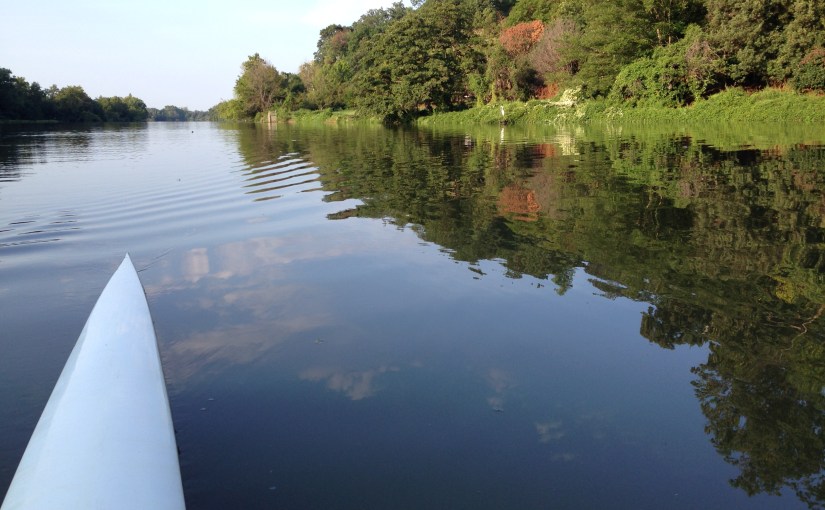
For me the smell of the river awakens some deep, visceral connection to my past. I  spent so many mornings of my early adulthood pulling an oar through the water that the river has become part of my psyche. The river continues to welcome me and, as I age I appreciate it even more. In the early morning, it smells of wet earth and a world of turtles, birds and fish waking up. This is unlike the Monongahela River, where I learned to row 1978, and it’s completely different from the Potomac River, where I still occasionally ply the waters. For 10 years I’ve been carrying a 24-foot racing shell on my head down to the low rowing dock at Bladensburg Waterfront Park. When I put my boat in the water at 7:00 am on a Saturday, I can see the ethereal morning mist rising up from the river.

The first thing I notice is the tides. If it’s low tide I can see the mud flats reaching into the middle of the river, with ducks and geese squatting on the embankments. I know to avoid these areas because if my skeg gets caught, I’ll have to get out into the thigh-high mud and push. I don’t want to join the Anacostia Swim Team, an exclusive organization for those who fall out of their skinny singles. Or those who didn’t see the hidden logs lurking just below the surface. The second thing I notice is the debris. Did it rain last night? What detritus and branches will I have to dodge? The most beautiful time is a late September morning when the colorful leaves reflect on the water, when the tides are just right and the surface is glassy. On a Saturday morning in early fall, you can see bald eagles with fish in their talons, circling above. Black cormorants stretch their wings to dry from a tree-top perch, like some Dracula opening his cape. White egrets linger into October and dot the shoreline.

In the afternoon, it smells of high school students’ sneakers left on the dock. DeMatha, Seton, Walter Johnson, Blair, Churchill, and Montgomery Rowing all row out of Bladensburg Waterfront Park, as well as Catholic University, University of Maryland, and Washington Rowing School, of which I am a member. In the afternoons it is a chaotic cacophony of boats launching, coxswains shouting, coaches’ motorboats puttering off, yellow buses idling in the parking lot. Once the crews have pushed off, it smells of rich mud and photosynthesis. It’s a smell that says, “Keep Out!” if I turn my head one way and “Welcome Home” if I turn my head the other way.

In the middle of the river, you can see concentric circles where fish have leaped up. Osprey sit singly in the sparest craggy branches of the dead trees. Sometimes you can spot a deer swimming or a other mammals. Once when I was coaching a high school team, the girls Varsity Eight stopped rowing suddenly. I was upset that they weren’t executing the workout plan the way I’d told them. “Wait, stop!” they shouted. I pulled up next to their Eight in my motor boat. “Why did you stop rowing in the middle of the piece?!” I yelled from a megaphone. The girl in Bow Seat gestured at her long oar. I thought maybe her blade had caught a hidden obstacle and the boat was stuck. I wondered what tools I would need to get out of my bag. Instead, there was something I’ll never forget: a baby beaver had swum up to the boat and was resting on the upturned blade of her oar before swimming across the river. I guess he just needed a break.

What I know about the Anacostia River is that it gives us all a break. It is no longer the open wound filthy with pollution, chemical waste, and trash. Even though commuters rush across the New York Avenue bridge without a second glance, that will soon change. The Anacostia used to be a sluggish gash dividing Washington, DC into the Haves and the Have Nots. Anacostia, the community, used to be known for its food-desert neighborhoods, for neighborhoods so riddled with crime and poverty that for decades there wasn’t even a supermarket. At least that’s what I heard on the news. The Anacostia runs past the Anacostia Community Boathouse, a yacht club, and the Navy Yard, where the last tall ship was towed away before the drawbridge is replaced with a fixed-span bridge. It runs past RFK stadium where football and soccer events still draw crowds. There’s now a high-concept walkway accessible to the public just down from the Navy Yard, a welcoming feature where once there was only rubble. “If you build it, they will come.” And they have come. And they keep building. And that’s a good thing, I think.

Rowers have long known the secret world of nature and beauty that is the Anacostia River. The new Anacostia Riverwalk Trail is due to be finished this fall, and will soon delight newcomers the way it’s delighted rowers for years. DC’s “forgotten river” is the one that unites all of DC. It’s the river that draws us to an unexpected natural world of phenomenal beauty in the heart of the city. What I know about the Anacostia is that it’s finally getting the attention and respect that it deserves.

Boys in the Boat

When I first rowed in college (1978), people said our boat had been in the 1936 Olympics. At the time I thought it was a joke, but now I’m not so sure. We were a ragtag startup team at WVU. We kept our shells in an old tractor-trailer truck behind the lumberyard on the Monongahela River. That thing was so heavy that our old coach made the men carry it for us! Of course, that could have just been because he was 70 years old and didn’t have a clue how to coach women – it had never been done before!

I’m excited that The Boys in the Boat is coming to PBS on August 2nd, just in time for another Olympics. I read The Boys in the Boat by Daniel James Brown when it first came out in hard back. The oddly-stylized first 50 pages really annoyed and distracted me – as if Brown were writing a 1930’s news article instead of a book for a modern audience. It was also clear to me that he wasn’t a rower. But the story is so compelling and well told that I slogged through – and was immensely rewarded. Back then rowing was still the sport of gentlemen, and the strapping young loggers and woodsmen of the Northwest had a distinct advantage over their elite East Coast rivals. After all, it was only 16 years earlier that Jack Kelly, the father of famous actress Grace Kelly, was excluded from the Royal Henley Regatta in England because he was a bricklayer. It didn’t matter that he had won dozens of U.S. Championships; the fact that he was a manual laborer was enough to ban him from the regatta.

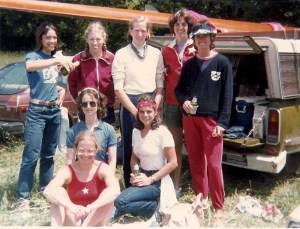
When I first started rowing it was still very much a sport for men, but things were changing rapidly. I moved to Washington DC in 1979 and joined Potomac Boat Club on the Georgetown waterfront. We had a small bathroom, but no showers or lockers for women were available, not yet. There was one group of women already rowing there; they had all graduated from Ivy League schools, where Title IX had guaranteed some access to the sport for women. They were much better than my motley crew of WVU graduates and friends of friends. I used to telephone about 20 people every night just to get enough young women to put together an Eight for the next morning. The women already rowing at Potomac Boat Club didn’t talk to us for two years – not until we announced that we were planning to race at the Head of the Charles in 1981. We hired a coach, added to our practice schedule and improved so much that we combined forces with the MIT-Georgetown-Wellesley alumnae for my first races after college. To prepare for Masters Nationals, we often practiced twice a day. I didn’t own a car, so I biked down to the boat club at 5:00 am, worked eight hours, biked back down to row in the evenings, then biked home through Rock Creek Park, straight uphill to my house on Military Road. I was in really good shape. Rowing was my life for an intense two years. Then in 1982 I joined the Peace Corps, moved to West Africa and didn’t row for another 18 years. Rowing has shaped my life.

Potomac Lights at Masters Nationals, 1982