Teacher Time Out

Two weeks into my summer break and I’m already missing my teacher ‘leagues. I wake up without an alarm and stumble through my day with no bells to mark time. Who’s going to keep me on track with my long To-Do list? Who’s going to remind me what the schedule is today? What time that PLC meeting starts? What I have to read or click through before moving on? Who’s going to discuss that message with me? Or what spirit wear is it tomorrow? Who’s got the latest chisme gossip?
The What’s App group chat has gone silent and I don’t know what to do without the daily videos, Q & A, jokes, or the one teacher responding three days late to a message long forgotten. I haven’t yet left behind the chaos of my ordinary school life, moving among five different rooms every day, maneuvering through hallways teeming with students larger than me and in no hurry to get to class, sitting in a loud office where I can’t get away even when I put on headphones to signal I’m off-duty.
It’s funny that I miss the noise and over-stimulation of school, but am quickly adjusting to “summer mode.” I’ve already completed a little road trip, a rowing regatta (where I won a medal just for showing up), a Primary Election, a mini family reunion, and a visit to the Tall Ships in Baltimore.
On my schedule this summer are meet-ups with teacher friends. A lunch, a karaoke night, a walk in the park, a rowing date, and evening drinks at a brew pub. That’s how I pass time in the summer. Seeing colleagues outside of school keeps me grounded and helps me reinforce who I really am. Ten months a year, a teacher’s identity is shaped by others, as we comply with rules and expectations.
During the summer, we’re free to celebrate who we really are. I’d feel a little lost without teacher friends to join me.


On the way to Liberty Island. I lived in Manhattan for 10 years, but never once visited the Statue of Liberty
View from my table LES

What we miss makes us stronger

During the holiday season, I miss my mother. I miss talking to her, sending a greeting card, or buying her a little gift. I miss her energy. As much as I complained about driving the 400 miles from the DC suburbs to Huntington, WV, it was our family ritual – the car loaded up with gifts, stopping near Cumberland, MD at the same McDonald’s. One year we saw Santa on a motorcycle drive past. My mother loved that.

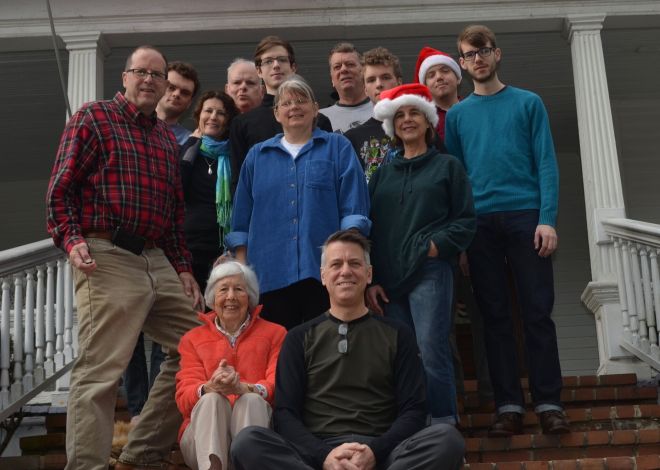
Until she passed away in 2021, we gathered at my mother’s large Victorian home on the Ohio River, 21 of us staying up late every night, enjoying board games or singing around the piano. She was never the first one to bed because she didn’t want to miss a thing. Mum put so much effort into hosting us every December — a beautiful, live Christmas tree, delicious meals, carefully-set tables, opening presents one-at-a-time so we could ooh and aah with every reveal. She thrived on having the house full of children and grand-children well into her 90s.

Robin Winn, a sort-of relative (my sister’s sister-in-law), human-design guru and author of three books, talks about “the deep, velvety essence” of Joy surrounding the holidays, a kind of collective energy that begs to be shared with all of humanity. My mother had that joy during the holidays, and I think it’s rubbed off.

After a couple of years of painful transition, I’ve internalized the decades of Mere-Mere’s Christmas joy. A new type of holiday, a quieter one, where I can experience “luminous joy” simply by being with other people in celebration, has taken hold. I decorated my house, I cooked good food, and accepted every holiday invitation that came my way. I am eager to learn more about the “awakened possibilities” that lie ahead.

I still miss my mother, but know she’ll always be with me every Christmas.

Repetitive Movement

John is in the woods near my house chopping fallen trees. His forceful grunts echo up the ravine as he slams down on logs over and over and over again. 

My nephew paces the floor when he visits, around and around and around. 

My son plays video games from the moment he wakes up, clicking, tapping, and exclaiming. 

Repetitive physical movements have a calming effect that can reduce our fear and anxiety over things we can’t control. Like the uncertainty and chaos of the entire past 20 months. 

Writer Annie Dillard observed that “how we spend our days is how we spend our lives.”

If that’s the case, I need to examine how I spend my days.

During quarantine, I walked outside twice a day and wrote short stories, poetry, and personal essays. After Zoom classes, I played my recorder behind closed doors. In warm weather, I rowed on the Anacostia and Potomac rivers. I built a fire in the fire pit and sat outside with friends and neighbors. 

These routines got me through the worst of the pandemic.

I’m holding on to them like a prayer to get me into next year, because who knows what 2022 will bring?