Choosing Board of Education Candidates

I was privileged to be part of a MCEA panel that interviewed candidates for the Montgomery County Board of Education At-Large seat. I’m an Elected Faculty Representative at my school but as far as I know, this was the first time that ordinary teachers were asked to participate in such a forum.  It was tedious but thrilling work, and we all took it seriously. Somehow it reminded me of serving jury duty. Even with a light dinner and an opportunity for small talk with colleagues beforehand, it felt like an important obligation. I was impressed that we stayed well into the evening debating who to support.

Five candidates submitted answers to a questionnaire in advance, which we read and then scored, kind of like grading papers. Then we met with each candidate for 30 minutes, heard their prepared statements, and asked them the same questions in the same order. We made our recommendations to the Executive Committee, who then made recommendations to the Rep Assembly, which voted with more than 58% to NOT endorse a specific candidate for the April 26th race.

I’m reluctant to say more but I have to get it out there — teachers were wowed by Sebastian Johnson, the well-spoken young man who presented himself as an exciting, viable alternative to the incumbent. It is my hope that he’ll be one of the top two vote-getters and will run against Phil Kauffman in the fall.

This article in Bethesda Magazine says it all better than I can.

And now this post from the Parents’ Coalition of Montgomery County about the MCEA Political Action Committee. I have no idea what this is all about. I’m just a classroom teacher interested in helping elect Board members who listen to me before making decisions. I feel that I’m taking a risk even posting this.

Need for trauma-sensitive schools

I sometimes feel like I am on the front lines all by myself, defending my students from further trauma at the hands of the school system. No! I said recently when my Department Chair asked when I “wanted” to give my students the mid-year MAP-R test. I had to convince her that it was optional, really. I didn’t want this test because, even though the data is mostly useful, ESOL teachers have been testing just about every period, every day since January 6th. ( We test four areas of language proficiency: Listening, Speaking, Reading and Writing – we don’t know how the scores are calculated and we don’t even get them back until June AND to make matters worse, we have to test 60 students who are no longer getting ESOL services). The testing windows closes at the end of the week. What this means for people on the outside is that I, personally, have watched students take a test for more than 35 hours in the past six weeks. This does not include a week when we had no school because of snow. I have five colleagues who have each performed a similar number of proctoring hours. We cannot get back the 200+ hours of missed instructional time. These are the students who most need consistent and appropriate instruction in order to succeed in an English speaking world.

This excellent interview in Education Week Teacher doesn’t even mention testing; I just had to air that complaint and get it out of my system. In the interview, author Susan E. Craig mentions that adverse childhood experiences can impair a child’s cognitive abilities. She says that teachers and schools need to be more “trauma sensitive.” Those of us on the front lines are doing a face palm at the obviousness of this statement. Instead of zero tolerance and punitive measures that can force the child to reenact an earlier trauma, some of us have perfected the “warm demander” approach, where we kindly and with a sense of humor try to talk them into doing their homework or coming to class. If you saw my grade book this marking period you’d wonder how well it’s working. Sometimes my goal for the week is to keep one student from dropping out.

I don’t mean to make light of a serious topic. I commend Susan E. Craig for focusing on this issue. I have advocated for trauma-sensitivity in something as simple as a Code Blue drill. Some of our ESOL students have lived through war-like situations – so don’t yell at them to “get down” and “cover your head” without giving teachers a heads-up so that we can provide some context – the buffer that Ms. Craig is talking about here . One thing she says that I cannot repeat enough: students who have lived through trauma need consistency and predictability. All this testing disruption undermines the very nature of cumulative progress.

And can I add one more thing? I have posted about how stressful this year feels. Recently a friend suggested that I stop caring so much! At least now I have some back up. See the quote below from the Ed Week interview with Susan E. Craig, author of Trauma-Senstive Schools: Transforming Children’s Lives (Teachers College Press).

Another challenge is giving teachers enough information and support to avoid being traumatized themselves by their over-exposure to the trauma children. It’s a very serious mental health issue that can come up for people that work with traumatized populations. I don’t think we do enough to help teachers recognize that and get the support they need to avoid having their own mental health compromised because of how stressed they are by the lives of the kids they’re working with.

To Bill Gates: Children are not apps

This article is long, but it’s too good not to share. The public has been duped by corporate messaging. This is a thorough, brilliant expository. Thank you for sharing, Diane Ravitch!

Economic reform is being driven by 3 things: economic self interest of the white middle class, racial and ethnic antipathy, and corporate profits.

Did you know that America is growing browner, older and deeper in debt? Who do you think feels threatened by the fact that 25% of all children under age 5 are Hispanic?

Bill Gates wants to unleash “powerful market forces” on public schools. In other words, he wants a piece of the profits to be made while testing our public school children into oblivion. Thank God Pearson stock and Arne Duncan are in a downward spiral.

Can we get back to teaching now?

Talking Down to Teachers

I haven’t read The Smartest Kids in the World, mostly because the title is such a turnoff, but I loved Amanda Ripley’s Unthinkable: Who Survives When Disaster Strikes. So when I saw her “Talking Down to Teachers” article in the February 2016 Washingtonian Magazine, I was fascinated.

Thank you Ms. Ripley for praising teachers’ professionalism and intellect, and making an effort to change the dialogue about teachers-as-missionaries. But I want to know: Who are the “highest performing teachers” being honored at the Standing Ovation event you described? What is the criteria for selecting these teachers? We should be questioning the value of elevating teachers based on artificial measures, like test scores of children, when most education professionals recognize that external factors (like wealth & poverty) are far more influential on student success than any one teacher.

When people hear I’m a teacher, they say “that’s courageous” and imply that I am making a sacrifice to do what I love. Like the DC teachers she quotes in the article, I am not a volunteer; I am a well-paid professional. Yes, it’s hard work. Yes, I work very long hours. But what I (we) really need is respect. Respect from the parents who entrust me with educating their children, trust from my administration that I am doing my job, trust from the School Boards and the taxpaying public that I am a well-trained professional making good decisions and making a difference every day.

And by the way, not once in my 15 years of teaching in MCPS has any parent group passed the hat to buy me a gift. All my students are immigrants and they don’t know this American practice. I think it says more about the parents in Ms. Ripley’s school district than anything else. I’d be happy for thank you from the students at the end of the year!


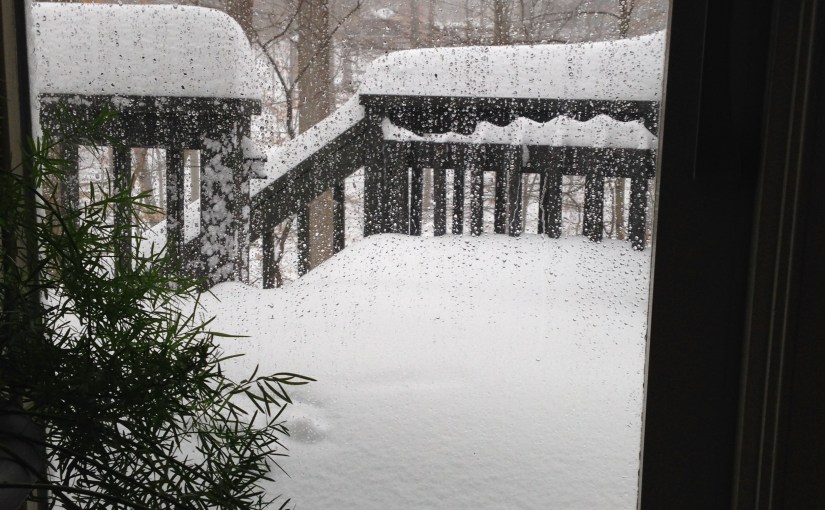
Snow Day, Good. Timing, Bad

Usually snow days are a teacher’s best friend. However, like most teachers at the end of the semester, I had a long list of tasks to accomplish and was looking forward to two days alone in my classroom with no students to distract me. WiDA ACCESS testing has taken up every testing block — that is, when I wasn’t giving a Semester Final Exam — and I had zero time to grade papers and plan for next semester. I was also looking forward to clearing out old papers, cleaning and getting materials organized. I’m going to be sharing my classroom now with another teacher because we’ve got 18 newcomer students and her classroom is too small. So she’s moving into my classroom during my planning periods, and I will be exiled to the office. I don’t mind, but my clutter is an embarrassment.

When I heard the weather forecasts, I stayed late on Thursday and graded all my semester exams — including the exam for a student who showed up late for a “make up exam” without any warning. Even though she had failed the first quarter, had failed the second quarter and had 19 absences, my department chair and my administrator both said to let her take the test. I was feeling conflicted about the whole thing, but they confirmed my natural instinct to give students the benefit of the doubt. Our grading policy says that a student who gets a C on a final exam can still pass the semester, even with the above profile! On the one hand, I want to ask: Why bother coming to school? Why bother doing any work? On the other hand, I understand the difficult circumstances of some students and how my giving her a passing semester grade might make her life just a little easier; maybe this will be the little break she needs in order to succeed next semester and in life.

So I sit at home watching the snow fall, trying to catch up on my reading-for-pleasure, all while feeling a little guilty that I’m not preparing a scope-and-sequence for the three different classes I will teach starting on Tuesday. And what about my reflections on the Student Learning Objective that is due January 29th? And did I file the quarterly COSY report?

I think I’ll go shovel some snow and curl up with Gone Girl, which I’ve been wanting to read forever.


Worried about security abroad?

I heard about last Friday’s attack at the hotel in Burkina Faso from my sister. She texted to ask about my husband, who travels all the time — often to countries where the color of his skin could easily make him a terrorist’s target. “Is he safe?” she asked. It’s a question I ask myself every time he travels.

On his most recent trip to Northern Nigeria — the heart of Boko Haram territory — I worried that he might be victimized. Instead of being taken hostage, he came back with amazing photos of himself surrounded by community elders wearing long robes and local leaders in colorful scarves, who welcomed him warmly and praised the work his organization was doing. He interacted with them in the local language, Hausa, which he learned years ago as a Peace Corps volunteer.

Every time there is an overseas attack in the news I don’t have to wonder why international nonprofit organizations keep sending staff and volunteers to work in developing nations. My husband’s and my own experience make me understand how important it is to share medical advances, expertise, and knowledge. The extremists who commit these violent acts do not represent the people, religion or places they come from.

I was also a Peace Corps volunteer and have lived, worked and traveled in developing countries. My Peace Corps service was a long time ago in a different international climate. Back in the 1980’s I never felt that I was in danger. In the 1990’s I lived through a coup d’état and an outbreak of Ebola, but I never felt the fear that more recent attacks want to promote. Last summer I traveled to Southeast Asia with a group of educators, and felt a warm welcome from people whose language I did not speak. I met with fellow teachers and visited schools. They made us friendship bracelets and we donated books to their library. In 2014, I traveled to Central America with a church group to work on a school. Instead of being harassed, we shared in a powerful community-building project that was part spiritual and part practical. I gained a deeper understanding of their families and culture, and they of mine. It is through the act of meeting people, sharing stories, and performing public service together that we break down the walls between us.

Now that American aid workers, missionaries and volunteers have actually been targeted, I can no longer naively believe that there’s a sort of immunity for doing good deeds. But the risks of sending Ameritans overseas can often seem exaggerated in the wake of unexpected violence. Don’t we have an obligation to continue our support of people in faraway places who live with this threat of violence every day?

My husband is traveling to Kenya next week. I know that there is always a risk of danger, but I have to trust that he will be safe.

Absorbing student stress

This is my 15th year teaching English Language Learners in Maryland public schools. Why does it feel so much harder than last year? I have small classes and no new curriculum to pilot. I have access to excellent bilingual counselors and parent community coordinators. I have hard-working colleagues and a supportive administration. The workload is tough, but manageable. I should feel lucky, but I think the problems that students express to me are greater this year, and I seem to be absorbing more of their stress.

Challenges of immigrant families are making headlines this week, as deportations increase. But the news reports don’t tell you about other issues that bleed into the classroom. One student is in the hospital because he was in a serious car accident (was he driving?), another is out because a family member passed away, a third student was crying in class (different from the one I mentioned last week) and could not concentrate, a fourth student wrote an essay about witnessing a murder. Any one of these incidents would be a major life event for a typical teen. For immigrant children, their problems seem to be magnified by low income, family instability and lack of background knowledge. So often I act in loco parentis that I believe that I am the only advocate that they have. Two students welcomed new baby siblings this week and I made sure other teachers knew that’s why A’s behavior was a little off and K was absent so much. I bought a condolence card on the way home so that all the students can sign it before Y comes back to school.

In each class, I have at least one older student who is in this country with no family. D. crossed the desert on foot when he was 15. A “coyote” was leading his group from El Salvador. They walked at night when it was cool and dark. He slept in the sand during the day with tree branches covering his body so that the police wouldn’t find him. One day he woke up and all of his group was gone. He was hungry and thirsty. When the Border Patrol found him, they took him to jail and connected him with his aunt and uncle in Maryland, where he would await a court decision. He’s still waiting. In the meantime, he’s living with some friends (a girl who dropped out last year). One day he said to me, “I wish you were my mother.” I don’t know if deportation is on his mind, because he doesn’t linger after class any more to chat; he’s working full time.

In 2014, we welcomed a huge new group of newcomers to my school — students whose stories are beginning to come out as their language skills evolve and the trauma of leaving home starts to fade. When I ask these students to write about the family, they write “my beautiful mother,” and put “meeting my mother” on their autobiography project timelines. At least five students in each class moved to Maryland to live with a parent whom they haven’t seen in many years. One girl was ecstatic because her mother and sister were about to arrive. She hasn’t seen them in nine years. My typical student is living with a parent who is remarried and has little American children with a step-mother or step-father, all of whom speak better English than my newcomer student.  Sometimes the missing parent is put on a pedestal for so many years that the real version of Mom or Dad can only be a disappointment after so much fantasizing and anticipation.

As the semester is wrapping up and we enter testing season, I notice the disconnect between where students are and where we’re supposed to be. I’ll have to admit that I don’t like the new Pearson book that is a substitute for our curriculum. I used to teach Romeo and Juliet, The Giver and Of Mice and Men. We used language structures to discuss the bigger issues that these classics addressed. Some of it was relevant to students’ lives. Now we read excerpts from texts and we compare them to nonfiction pieces with the same theme. I teach language structures without the benefit of context because I know that grammar and vocabulary will appear heavily on the multiple choice exam. How am I going to ask students to make personal connections to Mendel’s Laws of Heredity? I put them in cooperative groups to answer a question and create a visual using academic language. How do visuals support the main idea? Discuss with your peers.  It’s partly what they need in the real world, but I really miss reading about their personal experiences.

By January, I usually know my students pretty well. This year, my grade book indicates that school is not a priority. I don’t think it’s pure laziness — although that’s certainly a factor. Students don’t see the big picture. I have to explain how semester grades are calculated and why it’s important. I assume that no family member can help them. I ask warmly for overdue assignments, create multiple opportunities for reassessment, and allow students to hand work in past the deadline.

Today I had a guest speaker, a vibrant young Latina student who is the first in her family to attend college. She talked to them about the importance of making a plan, discovering some internal motivation and using their time wisely.  They were polite and attentive. But as soon as she left, I had to reprimand A. for pushing another student.

Sigh. It’s all worthwhile, though, because one day soon I’ll watch them walk across the stage at D.A.R. Constitution Hall in Washington, DC and the principal and superintendent will shake their hand and it will be the proudest moment in their lives. An American diploma. And I’ll help them get there no matter what it takes.

Immigration Raids: Why are we deporting law-abiding families?

Happy New Year! Yesterday and today my students were visibly distracted. One girl had her head down and couldn’t work. When I asked her to sit up, I could see that she was crying. “La Migra” is all that students would say. They showed me a video of a raid. A mother had 10 minutes to pack her own and her daughter’s bag for deportation. Students are telling me that ICE (Immigration and Customs Enforcement) police are making raids on homes, stopping cars in traffic and showing up at the mall. “My mother doesn’t have papers,” one girl said. “But my brothers were both born here. What will happen to them if my mother is deported?” Another student told me that her mother is afraid to go to the supermarket because immigration police are there. “We don’t have any food in the house,” she said. I assured her that school is a safe place to be. ICE cannot enter school property and teachers are not required to give out information.

I don’t understand this new policy of tearing families apart. The newspapers report here that El Salvador has become the murder capital of the world. These families are fleeing extreme violence and should be welcomed as refugees. Many students have already lived through warlike trauma. Why are we retraumatizing them? Most are law-abiding participants in the U.S. economy. They work and pay taxes. They perform jobs that many Americans will not take: cleaning houses, construction, retail sales and restaurant work.

We are about to enter TESTING SEASON. My students will have back-to-back tests. The first is a semester exam that includes separate Listening, Speaking, Reading and Writing sections administered over two days. The second is the WiDA ACCESS, a state-mandated test for English Language Learners that also includes Listening, Speaking, Reading and Writing sections administered across several days. Some seniors will also have to take High School Assessments that will determine if they can graduate in June. On top of that is MAP-R, a computer-adapted Reading test that some students will take. How can they concentrate when so much in their lives is outside of their control?

I wish the politicians could see the effects of their policies in my classroom. So many students are suffering horribly through challenging family situations, yet they come to school and sit through a barrage of (meaningless) tests because we ask them to do so. They want a high school diploma and are very motivated to stay in school. The American Dream is still alive. Why are we making students sag under such a heavy load?

A charter model I can support

This article about an unusual boarding school in Washington DC just might change my mind about charter schools. I applaud how the Monument Academy is trying to address the social-emotional needs of students who experience ongoing trauma. I am not an expert, but I see some of these same behaviors in my own classroom. If students are placed in a stable, supportive, home-like environment, can the care and attention possibly make up for years spent with violent, abusive role models or moving between foster homes? I’m sure that I won’t be the only one following this story eagerly in 2016.