Since the inauguration of The Vulgarian, I seem to have lost the ability to write about kittens and puppies. Everything I read online makes my heart beat faster and I can’t sleep at night. This is all I can say right now.
When my husband Frank and I first set up house together 26 years ago I knew that we would have greater challenges to face than what to serve for dinner. I grew up in a large family where my mother miraculously prepared a well-balanced dinner for nine people every night. It wasn’t gourmet but it was predictably bland and coordinated with military precision. He came from a small, Italian family with a mother who would drive 25 miles just to get a single ingredient to make a new recipe and a father who had once been a cook in the Navy. His grandfather owned a little deli in Rhode Island, the kind where sausages and cheese hung from the ceiling and kids at school made fun of him because his sandwiches dripped through the foil (but they would eagerly trade him their baloney on white bread for his Italian cold cuts). Frank intuitively knew how to make every meal taste delicious. I had no repertoire and usually burned things. So early in our marriage it was easy to defer to him on all things kitchen related. Except for one sacrosanct family recipe: rice dressing.
My family devoured this special Cajun side dish at every holiday meal growing up, either stuffed inside a turkey or served from an overflowing bowl that my brothers fought over. On our first wedding anniversary my mother gave Frank and me a simple, framed copy of her mother’s recipe, handwritten in Grandmère’s illegible script. “About 1 ½ pounds of ground meat… I cook it for about 1 hour with salt and pepper… add onions, green pepper and celery with red hot sauce… add cooked rice, stir up mixing well…” My grandmother died when I was very young, but I proudly carried on the Cajun tradition. Every holiday, I would cook the rice dressing days in advance so that I could be out of Frank’s way while he roasted the meat to perfection and created a gravy to die for. For years, I had that one dish to remind me that I was still competent at something in the kitchen.
When we first moved in together I tried to cook pasta his way, which of course was the only way. You see, I married a perfectionist. We used to call it spaghetti or macaroni growing up. I didn’t know anything about cuts like ziti or rigatoni. He reminded me that his pasta was far superior to anything I made. And he was right. So I boiled the water and added salt, set the timer and sat down to grade papers. Invariably Frank would go into the kitchen and take over. The few times he didn’t intervene, the pasta would stick together because I’d forgotten to stir it. Or I’d mess up the al dente timing. My husband didn’t finish my sentences; he finished my projects. And not just in the kitchen. At first I really liked it. In fact, all my friends and family really liked it too. But they say that the things that attract you at the beginning of a relationship can sometimes repel you later. That was the case with me. This year I’ve finally come to grips with it.
I learned about Frank’s handiness early on. He’d been a forester in Maine – which of course was a big selling point while we were dating – but we were living in Manhattan at the time, and there weren’t too many trees to identify, or logging roads to manage. He liked to organize and fix things. He was very handy. But a Mr. Fix-It with no garage and no truck has to find an outlet. There was only so much you could do in a 600 square-foot apartment in New York City. Frank started to cook more regularly. He bought a Romertopf clay oven and made delicious Tandoori chicken. We got a pressure cooker that could give us a kid-friendly beef bourgignon in 15 minutes. We got a rice cooker and he started going to all the Asian stores and asking the salesladies for their advice: Jasmine rice from Thailand or short grain Japanese rice grown in California? I developed a gourmet pot belly.
Friends would invite us for dinner and express delight that Frank fixed things that they didn’t even know were broken – stovetop fans, pictures that were hung crookedly, chairs that squeaked. “Can you believe she tries to slice meat with those dull knives?” he would exclaim as we left. He started to travel with a knife sharpener. His skills made me very popular in a new way with my old friends. I basked in his reflected glory.
But then his helpfulness started spilling into my domain. If I started laundry on a Sunday night and stepped away, he would put the clothes in the dryer then take them out and fold them all wrong. Neatly, though. I can’t say I look forward to doing laundry, but there is a certain satisfaction in finishing a job you start. Before I realized what was happening, he took over other chores as well. If I slacked off for a moment, he would be putting a second coat of polish on the shoes that I left out, or re-cleaning a stainless steel pot I’d washed because it wasn’t shiny enough. Who doesn’t like shiny pots? I didn’t complain. But it has made me kind of lazy. “You know that tea kettle you mentioned wanting to buy?” he said. “Well I went out and bought a better one.” He would produce the Number One rated item that Consumer Reports or Cooks Illustrated or America’s Test Kitchen agreed on. Don’t get me wrong – it was a great choice but I was deprived of the shopping experience.
“I wish my husband would do those things,” said my neighbor when I complained.
As the kids got older and I got busy with coaching and after-school projects, Frank started cooking regularly again. There’s nothing better than coming home to a hot meal after a 12-hour day spent almost entirely with teenagers. I was really appreciative that I didn’t have to make any decisions about food.
A few days before Thanksgiving this year, I asked him to pick up a green pepper and some ground beef. I had to work the Wednesday before and he didn’t. “I’m going to start the rice dressing tonight,” I said. He texted a few times from the supermarket. “The recipe calls for a mixture of ground beef and ground pork,” he said. “They have ground pork here already mixed with beef. Should I get some?” “Sure,” I texted back. It was annoying that he had checked Grandmère’s recipe – and knew it better than I did. I’d never followed it exactly, preferring my own version of the family specialty. Also because it called for “gizzards” which I think should be outlawed. “It calls for hot sauce,” he said. “Can I use Sriracha instead of Tabasco?” Noooo! That was just too much a departure from the Cajun roots and respect for my family tradition, as if he’d slapped me in the face.
When he arrived home, I’d cleared the accumulated junk mail off the kitchen counter, washed the special platters and serving utensils so they’d be ready for the next day. I’d made a cake. I’d arranged the flowers, found the right decorations, napkins and silverware. I’d just sat down, put my feet up and was enjoying my first sip of wine, when Frank walked in with bags of groceries. “You look tired,” he said. “Do you want me to start the rice dressing?” What woman wouldn’t want to hear those words?
I considered for a moment. He had established dominance in the kitchen years earlier, he’d already taken away my autonomy in simple household maintenance, he’d usurped my domestic roles of laundry, dry cleaning and shoe repair. I didn’t mind giving up those chores. But my old-fashioned traditional rice dressing recipe? Could I relinquish my last vestige of kitchen competence? My self-esteem?
“That would be wonderful,” I said. All my fight was gone. Deep in my heart I knew that if he said ‘start,’ he would most likely finish it. Because he finishes all my projects. And he does them to perfection. So for the first time 26 years , I allowed myself to relax on the Wednesday night before Thanksgiving. My husband cooked my grandmother’s rice dressing recipe completely on his own without any pretense of checking with me. And guess what? It was delicious. I sulked a little when he got all the credit, but I had time to read a few chapters of my book and go for a walk in the woods. He’d one-upped me with the only meal I was confident I could make. And I didn’t care any more. In fact it was a relief.
When you are married for so many years, you learn to figure out your boundaries. It’s like doing a little dance forward and backwards without stepping on any toes. I had to step all the way back and relinquish control of my final family recipe to realize that my pride had just gotten in the way. What I learned from rice dressing is to truly appreciate that my husband’s competence has allowed me the freedom to pursue my own dreams.
I didn’t want to go to school this morning, the day after the 2016 Election. I woke up 5:00 am, as usual, and before I’d even finished my first cup of coffee my colleagues were texting and posting on social media. “What will we say to the children?” they asked. I felt sick to my stomach to hear the announcer on NPR say “President-elect Donald Trump.” This is the man who has bullied his way to the top with crass racist, misogynistic, xenophobic rhetoric that I have taught my students to avoid. They recognize him for what he is. They are fearful of deportation and discrimination. Now he has the power to turn his evil words into action. How could I reassure them when I felt so angry myself?
My fellow ESOL teachers had a pow-wow in the office. One had printed out “Know Your Rights” information that we made available last year when the immigration raids started in Prince George’s County. One was going to show an electoral map and explain the process visually. Another was crying openly. We agreed that we’d listen if students wanted to talk and would say that we didn’t have any answers. We knew that there might be some behavioral issues, especially with the newcomers. We would try to reassure them that school was a safe place. I decided to talk about the strength of our democracy, the power of the system of Checks and Balances. But inside I don’t know if it’s true any more. I’m churning and angry and scared. Because I think the American Dream has been crushed overnight.
During the morning announcements, students were more talkative than usual. When the student newscaster said, “Please stand for the Pledge of Allegiance,” I heard a chorus of boos. They refused to stand up. I was shocked! That’s what we did during the waning Vietnam War days when I was in high school. “No, Miss! We don’t support Trump!” I’d been teaching them the etiquette of hand-over-heart, silence and showing respect when the Pledge comes on. “He doesn’t respect us!” This is what Trump has engendered. Disrespect for the greatness that our flag represents.
As the day moved on, students wanted to talk openly about it less and less. Many had stayed up all night watching the returns come in. My bleary eyes matched those around me. I felt brain dead. Teachers expressed the numbness they felt when we ran into each other at the copy machine, in the hallways, eating lunch. I was trying not to see this as a repudiation of all that I hold dear: equal rights, human rights, civility. I couldn’t help connecting the text we’re reading in 3rd period, Oedipus Rex, to the elections. But the tragic flaw brought Hillary down, not Trump. “The hero’s downfall is partially his or her own fault, the result of free choice, not of accident or villainy or some overriding, malignant fate. In fact, the tragedy is usually triggered by some error of judgment or some character flaw that contributes to the hero’s lack of perfection… This error of judgment or character flaw is known as hamartia and is usually translated as ‘tragic flaw.’ Often the character’s hamartia involves hubris (which is defined as a sort of arrogant pride or over-confidence).” I think the entire Democratic Party was suffering from hamartia.
By the end of the day, students were trying to joke. “Ms. Sullivan – next year you won’t have a job any more!” That exact thought had crossed my mind long ago, but I dismissed it. The vast majority of my students are from Central America, and some are undoubtedly here without papers. Trump couldn’t possible evict 11 million undocumented immigrants, right? One of the reasons I went in to this profession is to share the joy of teaching immigrants about uniquely American opportunities. Like how in America, you can arrive with little money, no family connections, and get a good education. You can work hard and go to college or graduate and buy a car and a house. My grandfather immigrated from Ireland and worked as a steamfitter in the Boston suburbs. His children went to college and became professors and business people. In America you can avoid gang violence by living in the right neighborhood, and by making good decisions about your leisure time. My father regularly visited the library and won the state Spelling Bee and a trip to Washington, DC. You can imagine how proud his Irish-nanny mother felt to accompany him by train. In America you can be from anywhere in the world and go to any church you want. You can wear a head scarf and go to the mosque if you want. You can hold a rally and speak your mind or refuse to salute the flag if you want. Because that’s your right. “La migra!” they joked in 6th period. You can choose to take advantage of all that is here. Isn’t free choice and opportunity what the American Dream is all about?
But now, with a Trump presidency looming menacingly over us, my students are already limited in their choices because now Trump has unleashed an anti-immigrant, xenophobic plague that is already infecting us with fear. How will they be able to advocate for themselves in the face of bullies? I have to show them how to listen respectfully to others, how to disagree with an idea without demeaning the speaker. I have to teach them about the values that we hold dear as Americans. They fled their countries to hear the lessons that I have not yet taught. I think now, more than ever, my job is one of the most important ones in the country.
What we should say to the children is much better said in this Huff Post article that my colleague forwarded.
One of the characteristics Americans are known for is optimism. Tomorrow we’ll begin a Socratic Seminar for Oedipus Rex. I will urge my students to comment on the following: “The fall is not pure loss. There is some increase in awareness, some gain in self-knowledge, some discovery…Though it arouses solemn emotion, tragedy does not leave its audience in a state of depression. Aristotle argues that one function of tragedy is to arouse the ‘unhealthy’ emotions of pity and fear and through a catharsis to cleanse us of those emotions.”
I think America needs a Socratic Seminar to process these election results. We need to relearn how to talk to each other and listen respectfully. I won’t stand for bullying or put-downs in the classroom but I will stand for the Pledge of Allegiance, and I will stand up for the rights of my students.
What I know about the Anacostia is what others will find out soon, when the Anacostia Riverwalk Trail bike path opens in about a month. This DDOT video shows how the last segment of the trail moves north, up through Anacostia Park, Kenilworth Aquatic Gardens, under the New York Avenue bridge, toward Bladensburg Waterfront Park, where it will connect DC to Prince Georges County and to Montgomery County via the Northwest Branch Trail.
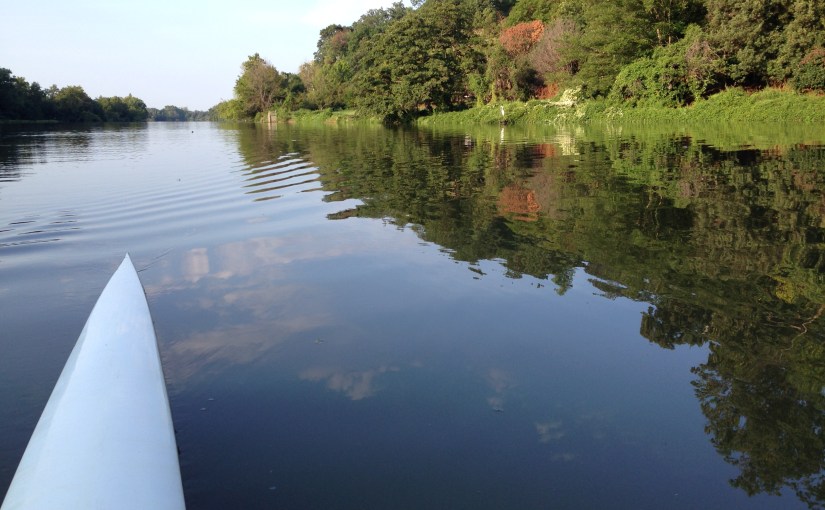
For me the smell of the river awakens some deep, visceral connection to my past. I spent so many mornings of my early adulthood pulling an oar through the water that the river has become part of my psyche. The river continues to welcome me and, as I age I appreciate it even more. In the early morning, it smells of wet earth and a world of turtles, birds and fish waking up. This is unlike the Monongahela River, where I learned to row 1978, and it’s completely different from the Potomac River, where I still occasionally ply the waters. For 10 years I’ve been carrying a 24-foot racing shell on my head down to the low rowing dock at Bladensburg Waterfront Park. When I put my boat in the water at 7:00 am on a Saturday, I can see the ethereal morning mist rising up from the river.
The first thing I notice is the tides. If it’s low tide I can see the mud flats reaching into the middle of the river, with ducks and geese squatting on the embankments. I know to avoid these areas because if my skeg gets caught, I’ll have to get out into the thigh-high mud and push. I don’t want to join the Anacostia Swim Team, an exclusive organization for those who fall out of their skinny singles. Or those who didn’t see the hidden logs lurking just below the surface. The second thing I notice is the debris. Did it rain last night? What detritus and branches will I have to dodge? The most beautiful time is a late September morning when the colorful leaves reflect on the water, when the tides are just right and the surface is glassy. On a Saturday morning in early fall, you can see bald eagles with fish in their talons, circling above. Black cormorants stretch their wings to dry from a tree-top perch, like some Dracula opening his cape. White egrets linger into October and dot the shoreline.
In the afternoon, it smells of high school students’ sneakers left on the dock. DeMatha, Seton, Walter Johnson, Blair, Churchill, and Montgomery Rowing all row out of Bladensburg Waterfront Park, as well as Catholic University, University of Maryland, and Washington Rowing School, of which I am a member. In the afternoons it is a chaotic cacophony of boats launching, coxswains shouting, coaches’ motorboats puttering off, yellow buses idling in the parking lot. Once the crews have pushed off, it smells of rich mud and photosynthesis. It’s a smell that says, “Keep Out!” if I turn my head one way and “Welcome Home” if I turn my head the other way.
In the middle of the river, you can see concentric circles where fish have leaped up. Osprey sit singly in the sparest craggy branches of the dead trees. Sometimes you can spot a deer swimming or a other mammals. Once when I was coaching a high school team, the girls Varsity Eight stopped rowing suddenly. I was upset that they weren’t executing the workout plan the way I’d told them. “Wait, stop!” they shouted. I pulled up next to their Eight in my motor boat. “Why did you stop rowing in the middle of the piece?!” I yelled from a megaphone. The girl in Bow Seat gestured at her long oar. I thought maybe her blade had caught a hidden obstacle and the boat was stuck. I wondered what tools I would need to get out of my bag. Instead, there was something I’ll never forget: a baby beaver had swum up to the boat and was resting on the upturned blade of her oar before swimming across the river. I guess he just needed a break.
What I know about the Anacostia River is that it gives us all a break. It is no longer the open wound filthy with pollution, chemical waste, and trash. Even though commuters rush across the New York Avenue bridge without a second glance, that will soon change. The Anacostia used to be a sluggish gash dividing Washington, DC into the Haves and the Have Nots. Anacostia, the community, used to be known for its food-desert neighborhoods, for neighborhoods so riddled with crime and poverty that for decades there wasn’t even a supermarket. At least that’s what I heard on the news. The Anacostia runs past the Anacostia Community Boathouse, a yacht club, and the Navy Yard, where the last tall ship was towed away before the drawbridge is replaced with a fixed-span bridge. It runs past RFK stadium where football and soccer events still draw crowds. There’s now a high-concept walkway accessible to the public just down from the Navy Yard, a welcoming feature where once there was only rubble. “If you build it, they will come.” And they have come. And they keep building. And that’s a good thing, I think.
Rowers have long known the secret world of nature and beauty that is the Anacostia River. The new Anacostia Riverwalk Trail is due to be finished this fall, and will soon delight newcomers the way it’s delighted rowers for years. DC’s “forgotten river” is the one that unites all of DC. It’s the river that draws us to an unexpected natural world of phenomenal beauty in the heart of the city. What I know about the Anacostia is that it’s finally getting the attention and respect that it deserves.
This NPR story about domestic violence and how it affects every student in the classroom is relevant to me. When students act out, you have to wonder what’s going on at home – but this data is alarming! Is it true that 10 to 20 percent of my students experience domestic violence!? Wow! Based on student behaviors in some of my English Language Learner classes, I think the percentage might be on the high end. Students are often reluctant to discuss what is happening at home, but I have the unusual fortune of getting to know students over many years and, once they feel safe with me, they will reveal what’s happening in their lives. Sometimes it’s shocking. Like the student a few years ago who stopped coming to school because she was worried about her stepfather beating her mother while she was gone. The student rationalized that she needed to stay home to protect her mother. In those days teachers did not have the same reporting requirements that we have today. I referred her to the counselor and made a copy of an essay she wrote – in case Child Protective Services was called in. I don’t know what happened to her, but I hope the cycle is broken now that she’s in the USA where help is available (see below).
It’s early in the school year, and I already see the cries for attention. We have so few counselors for the number of students who need help. I hope to be the one person who shows respect to them, who listens and who cares. I feel gratified that one of my seniors, who had me as a freshman, has written in a letter stating that she always felt relaxed the moment she walked into my classroom. That makes me feel hopeful that this year I can be that refuge again. I really love high school students and I love teaching. It’s a privilege and an honor to help develop the workers and leaders of tomorrow.
Here is a link to Domestic Violence Help in Montgomery County MD: http://www.montgomerycountymd.gov/circuitcourt/court/FamilyDivision/Domestic_Violence/dv.html#DV-On-line-Resources
I spent the first day of school on an international flight from Munich, where I attended the most spectacular wedding I will ever experience. I’m so glad my nephew married a German girl so that I could visit that Bavarian city and get a taste for lederhosen and dirndls, bier gartens and trains that run on time. This is the first time in 16 years I’ve missed the first day of school and it was well worth it.
The reality check came when students showed up this morning expecting something from me and I could barely remember how to turn on the smart board. As an ESOL teacher I get to know my students pretty well from year to year. The best part is seeing last year’s students after a long summer. They look a little older, a little more relaxed and happy to be back. M.B. told me she spent six weeks in summer school, has passed all her exams and is proud to be a senior. Finally. She gave me a hug. I love the nervous smiles of the new kids in each class, the posturing of the familiar faces back for a second (or third) year of Ms. Sullivan. Poor things! And I love the excited wishes and goals that each student brings at the beginning of a new school year.
What’s going to make this year truly memorable is that I will be teaching Honors English 12 for the first time. And what happened today leaves me feeling both nervous and thrilled at the same time. First of all, they asked me how the wedding was. That means they read my letter to them. Second, most had completed the homework assignment and written a letter back to me! A couple of students even asked how to turn it in online! They were already ahead of me. (They don’t get their new passwords until tomorrow.) I quickly calculated the rapid succession of successful events that must have taken place, and I stood with my mouth agape. Or maybe it was jet lag. Not one of the 29 students asked to go to the bathroom. Wow, I thought to myself. This year is going to be a really different experience for me.
Don’t get me wrong – I love teaching ESOL. But after so many years, it’ll be a welcome challenge to work with students who already know the culture, whose language skills are developed and who understand the idiomatic expressions in my lame puns. I shared some of my hopes and goals with them and I can’t wait to read about theirs. I hope to learn from them as much as they learn from me. I have high expectations for all my students, but today I realize that these Honors students will also have high expectations for me. This is the best kind of challenge to come back to. Each of us will work hard because those around us are motivated by the same thing. Seniors. Who are motivated. This year will be different and better because of my students.
It’s hard to believe I was in Munich yesterday morning. Now can I go to sleep? Gute Nacht!
While most of America is focused on the darling gymnasts and the freakishly talented swimmers from my great state of Maryland, there’s almost no coverage of America’s greatest athletic success story: the U.S. women’s rowing team! For 10 years the women’s coxed Eight has dominated international competition. In this this wonderful New York magazine article there’s a complete story about their wins. But there’s almost no coverage of their phenomenal racing during the Olympics. What gives? Is this more of the sexism that’s been on display? Like the Chicago Tribune story that, instead of reporting on the Bronze Medal winner’s success, mentioned her only as the wife of a Bears football player.
I’m proud to be a long-time member of U.S. Rowing. I’m old enough to remember when it was the National Association of Amateur Oarsmen, but fortunately that name changed as more and more women poured into boathouses and insisted on equal treatment. Why hasn’t the coverage of women’s sports on network TV kept up with the times? Is it because they’re not wearing sparkly outfits? Come on, NBC, you can do better!
Speaking of outfits: one of my coaches participated in the 1976 Olympics, the very first one that allowed women to compete in rowing. In one way, we’ve come pretty far: she told us that their uniforms for the Opening Ceremony consisted of a purse and a hysterically funny and anachronistic undergarment – a girdle! Can you imagine asking Olympic rowers to wear something designed to hold in a fat stomach?! It makes me angry to think that our news coverage hasn’t gotten much past this era.
I am so proud to be part of a sport that offers such powerful, confident women a chance to compete and dominate on the world stage. I know that they don’t look anything like me – or like most Americans, for that matter – but they are my heroes. I have some idea what it takes to get to their level (and I don’t mean height), and I wish that they were getting the respect that they deserve.
So here’s to Katelin Snyder, Amanda Elmore, Eleanor Logan, Meghan Musnicki, Tessa Gobbo, Lauren Schmetterling, Emily Regan, Kerry Simonds, and Amanda Polk.
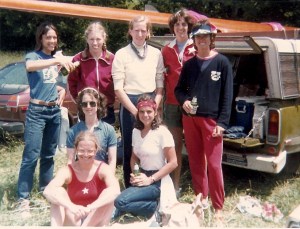
When I first rowed in college (1978), people said our boat had been in the 1936 Olympics. At the time I thought it was a joke, but now I’m not so sure. We were a ragtag startup team at WVU. We kept our shells in an old tractor-trailer truck behind the lumberyard on the Monongahela River. That thing was so heavy that our old coach made the men carry it for us! Of course, that could have just been because he was 70 years old and didn’t have a clue how to coach women – it had never been done before!
I’m excited that The Boys in the Boat is coming to PBS on August 2nd, just in time for another Olympics. I read The Boys in the Boat by Daniel James Brown when it first came out in hard back. The oddly-stylized first 50 pages really annoyed and distracted me – as if Brown were writing a 1930’s news article instead of a book for a modern audience. It was also clear to me that he wasn’t a rower. But the story is so compelling and well told that I slogged through – and was immensely rewarded. Back then rowing was still the sport of gentlemen, and the strapping young loggers and woodsmen of the Northwest had a distinct advantage over their elite East Coast rivals. After all, it was only 16 years earlier that Jack Kelly, the father of famous actress Grace Kelly, was excluded from the Royal Henley Regatta in England because he was a bricklayer. It didn’t matter that he had won dozens of U.S. Championships; the fact that he was a manual laborer was enough to ban him from the regatta.
When I first started rowing it was still very much a sport for men, but things were changing rapidly. I moved to Washington DC in 1979 and joined Potomac Boat Club on the Georgetown waterfront. We had a small bathroom, but no showers or lockers for women were available, not yet. There was one group of women already rowing there; they had all graduated from Ivy League schools, where Title IX had guaranteed some access to the sport for women. They were much better than my motley crew of WVU graduates and friends of friends. I used to telephone about 20 people every night just to get enough young women to put together an Eight for the next morning. The women already rowing at Potomac Boat Club didn’t talk to us for two years – not until we announced that we were planning to race at the Head of the Charles in 1981. We hired a coach, added to our practice schedule and improved so much that we combined forces with the MIT-Georgetown-Wellesley alumnae for my first races after college. To prepare for Masters Nationals, we often practiced twice a day. I didn’t own a car, so I biked down to the boat club at 5:00 am, worked eight hours, biked back down to row in the evenings, then biked home through Rock Creek Park, straight uphill to my house on Military Road. I was in really good shape. Rowing was my life for an intense two years. Then in 1982 I joined the Peace Corps, moved to West Africa and didn’t row for another 18 years. Rowing has shaped my life.

This summer I’ve had the good fortune to get everything I’ve asked for. I really shouldn’t complain, but I am so busy now that the summer is flying past and I haven’t even been to the pool once! The To Do list hasn’t gotten any shorter and I’m almost in panic mode. So I’m taking a deep breath, metaphorically, to tap into an overwhelming feeling of gratitude.
First, I was able to spend two entire, uninterrupted weeks with my mother in West Virginia. She is elderly and getting more forgetful and frail. I cooked dinner, planted flowers in her front yard, and I fed the neighborhood cats that gather on her back porch. These little things make her so happy. We drove along the Ohio River up to Point Pleasant, where the Silver Bridge famously collapsed in 1967 following all sorts of paranormal activity. We went to the Mothman Museum and she was a good sport, posing with a 6-foot black figure with red eyes just for a good photo opportunity. Every moment I spend with my mother is a gift. What is it about trying to help other people that makes one feel so content?
Second, I was given a summer organizing job I applied for with the teachers’ union. It’s something that I truly support – going out and having conversations with new (and not-so-new) teachers to find out what makes them tick. I used to be in advertising sales, so meeting with people and listening to their stories comes naturally to me. Who knows what will come of these collective conversations? But I met a guy who lives in my neighborhood – on my street! I didn’t know him before and now I do. If nothing else, at least I can say hi when I see him around. I value the face-to-face interactions that become so difficult once the school year starts.
Third, I asked to teach one English class next year. Instead of a class with new ESOL students with interrupted education, I’ll be teaching an Honors English 12. I’m really excited and, I’ll admit, a little nervous. I’m rereading all the classics I’ll be teaching – Oedipus Rex, Hamlet, The Stranger. I’m looking forward to interacting with students who will actually read for homework, and aren’t afraid to share their opinions. It will help me grow as a teacher and a professional.
And finally, I’ve been asked to race on Saturday. I’m too out of shape to pull an oar through the water in competition, but I will be sitting in the coxswain seat tomorrow and taking charge of a 8x at Diamond States in Delaware. I’m excited and nervous because we might actually win and they’ll toss me in the water if we do. That’s better than swimming in a pool, isn’t it?
The way I look at it is, if you don’t put challenges out there to yourself – especially as you get older – then you risk getting stuck in a rut. I feel the clock ticking away the summer days, but each morning I wake up excited to start on something new.
Now I can cross one more thing off my To Do list.
Last week I said goodbye to all the students who have hung out with me for 10 months. It’s a bittersweet time of year for teachers because we develop such a strong bond with our students. I’ve graded final exams and I’ll go in this week to clean out my classroom.
But I am still reeling from what some of them wrote in their final essays about a moral or ethical dilemma they faced. After reading their exams I had to get up from my desk and walk around the building. Most high school students are exposed to dystopian plots by reading science fiction stories, but my students have lived through such things.
One essay that particularly stands out was written by an African girl whose best friend disappeared. Nobody knew what happened to her. She knocked on neighbors’ doors and searched the community. She couldn’t believe that her only friend in the world would run away. Three days later the girl was found, barely alive on the edge of town. She was naked and bruised and filthy. My student went with her to a hospital and was there when her friend’s family walked in. Her friend started screaming hysterically and pointing at her own father, saying “get him out of here!” The father was apparently part of a cult that was required to perform savage acts on virgins. He was arrested and thrown in jail, but bribed the prison guards to be released. Shortly after, my student immigrated to the U.S. and her friend moved to another country. Thank god they were able to escape such horrors!
Another boy wrote about a classmate of his, a young woman forced into marriage at age 15. The following year she had a baby but unfortunately her husband died. The village elders accused her of murdering the man, but my student did not believe his classmate was capable of such a thing and stood up for her in front of his grandfather. The elders decided that her punishment would be burying her alive up to her neck then stoning her to death. My student remembered a quote from a movie he’d seen about how all humans have rights, so he went to a priest to speak up for his friend. The priest convinced his grandfather and the elders not to kill her; the girl was exiled to another village with her baby instead. It was his courage to speak up that saved the girl’s life. It’s impossible not to feel the pain of a 15-year-old processing such a real and profound ethical dilemma.
And you thought Shirley Jackson’s The Lottery was fiction?
I’m glad I have the entire summer to recover and plan. What new dilemmas will face these students this summer? I think I will teach differently next year, and I will try to be more sensitive to the quiet students and encourage them to write about their experiences more regularly. I will be thinking about this all summer.