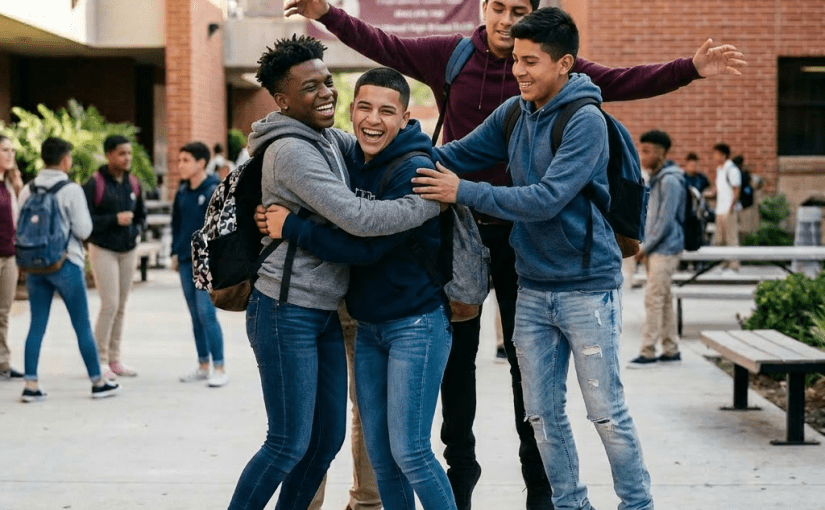
I’ve been teaching high school seniors for a long time. But ninth grade boys have a special place in my heart. They start the year doe-eyed and wary, then finish several inches taller and a lot more smart-ass. I teach a class full of them. With some girls, too — who are also great, just a lot more predictable. The boys enter the room for 5th period, posturing for each other and cracking jokes in Spanish that usually involve put-downs.
Emerson (not his real name) stakes his claim in the back row well before the bell rings, a backpack on the chair. He then positions himself at the door, a signal to friends in the hallway that he is ready to shoulder bump, man hug, or beg for a snack. The physicality of a ninth grade boy is something to behold.
“Don’t block the door!” I shout, remembering that a counselor asked me to keep two of them apart because of an altercation at the beginning of the year. The girls have to push past them to enter the classroom.
I start every class reminding them to take out their earbuds, put the cell phones away. Emerson arrives late, takes out a large McDonald’s bag, ice-cold drink in hand. His buddies in the back row start shouting, asking to share. I’ve become completely irrelevant.
When I give my best teacher reprimand, he exclaims, “Miss, but it’s free delivery! The Ride-On bus is free for students!”
He skipped 4th period to make a food run.
Seniors would be cool about eating in the classroom. They’d open their laptops or take out their folders and at least pretend to be engaged in the lesson while they munch. Ninth grade boys are feral. By 5th period, they’re also really hungry. I turn my back to begin teaching and I hear loud chewing and slurping sounds.
Once I finally start the lesson, girls sitting attentive with their folders open and the appropriate paper pulled out, one of the boys shouts a random “Six Seven.”
Some things are better left without comment.
We looked at a poem called “Where I’m From,” where the speaker alludes to learning Bible verses. I had a visual on the board and was trying to help them understand the nuances of the lines.
“Miss, do you believe in God?” Emerson shouts from the back row. I take a deep breath and try to give a measured response. Then I turn the question back to him, attempting to make a genuine connection with the class. The quiet students look up; I can tell they’re listening. We exchange a serious dialogue for a few moments, then I carefully guide us back to the poem.
This doesn’t happen with seniors.
As annoying as they sometimes are, I enjoy these teachable moments, where I can tell they’re engaged.
I’m a disciplinarian when I need to be, but my ability to overlook certain behaviors often gains me an edge.
“This is my favorite class,” David says. “You’re the only teacher who helps me.”
Two of these gangly young men now have girlfriends, puppy love in their eyes. Suddenly their clothing has become just a little nicer, their broccoli hair cuts trimmed and fresh. The horse play has two fewer participants.
They want to attend the trade school next door to learn electricity or automotive technology. I remind them that they need to pass all their classes if they want to be accepted into a program next year, that teachers often write recommendations for students. What would I say about them?
That I can see their focus begin to change as the year evolves. I can see who they are becoming more clearly. Maybe they can too. I can see that they’re annoying as hell sometimes. But it’s fascinating to watch them grow before my eyes — literally and figuratively. These kids will be all right. There’s a special place in my heart for ninth grade boys.


 Eva K. Sullivan