Complex Trauma in High School English Class

While all around me the federal government is being dismembered, it seems apt to bring up the novel we’re reading.

In English 12 we’re halfway through Margaret Atwood’s The Handmaid’s Tale. It’s hard not to draw parallels to what is happening in the U.S.A. today. I feel like Offred seeing the bodies from the “salvaging” hanging on the wall for the crimes they committed — men killed for gender treachery, doctors for performing abortions.

U.S. AID was butchered yesterday. The Department of Education last week. NIH before that. Canada is now an enemy. Undocumented immigrants are all criminalized. In Gilead, they know that nobody can be trusted. They know how dangerous scientists and intellectuals can be. “Eyes” are everywhere.

My EML students worry that family members will be deported while they’re at school, parents afraid to go to the supermarket or church. They bring these fears into the classroom, and either act out or remain unusually quiet. Some students just stop coming to school. Their anxiety seeps into our shared space. Whispered conversations, a heartfelt journal entry.

A teacher friend from another school told me that a student asked if she was legal. She is from South America and speaks with a slight accent. She replied, “I am now, but I wasn’t when I first arrived in this country.” The student responded, “Then I would have reported you to ICE.”

It could be worse. I could be a 53-year-old NOAA scientist with kids about to go to college — decades into public service, too young to retire, years of exceptional performance reviews — fired through a social media posting from DOGE.

I could be an undocumented LGBTQ+ immigrant about to graduate.

Seniors had to write an essay about the value and relevance of The Handmaid’s Tale for today’s teens. One student wrote that reading this text shows the consequences of not standing up against injustices in the world today. Another student wrote, “our government is meant to protect us, but if they ever turn against us, marginalized communities will be in the most danger.”

The fascist flexing taking place right now in the White House is meant to provoke fear and panic. Our president is inflicting continuous trauma on this country, with marginalized populations suffering the most. And they are sitting in my English 12 class.

Teachers have little training in how to deal with anxiety, emotional dysregulation, or persistent difficulties in sustaining relationships (symptoms of complex stress disorder), but we see them becoming normalized.

Ordinary, said Aunt Lydia, is what you are used to. This may not seem ordinary to you now, but after a time it will. It will become ordinary.

I have hope that my students will stand up against injustices, that they will fight for the future they want to live in. I will do everything in my power to give them the tools they need to think critically about our world. One of the best tools at my disposal is excellent speculative fiction, like The Handmaid’s Tale.

Because I live in Montgomery County, Maryland, I can (still) teach a novel that has been banned in Florida, Oregon, and Texas. This is exactly what we need to be reading right now. This is exactly what we need to be discussing. This is exactly how we can overcome the psychological stress of living through the next four years.
Soothing Summer Sunsets

With less than three weeks left of summer, the teacher anxiety begins to seep in. How many items have I crossed off my To-Do list? Can I still work in a trip to the beach? Have I read all the Quarter 1 core books yet? Completed my Compliance Training? Have I scheduled all my doctor and dentist appointments? Do I have an exercise/ socializing/ housekeeping plan in place that will work with my new fall schedule?

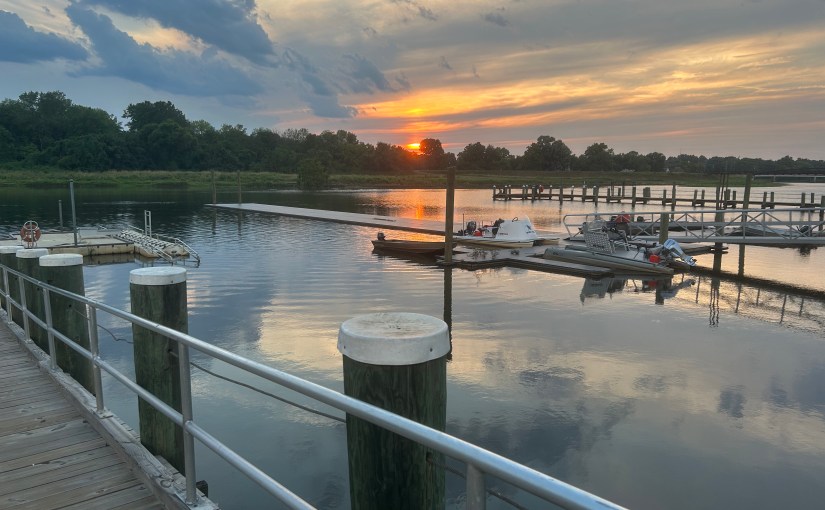
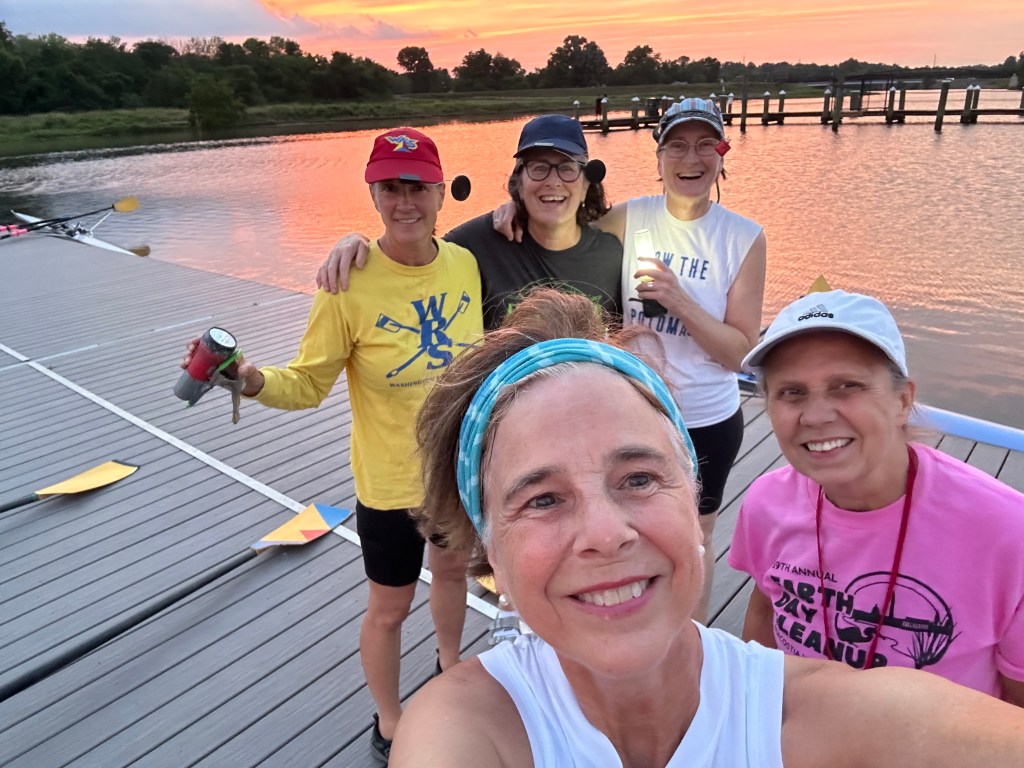
Wait! It’s not time to think about all those things yet! I’m watching the Olympics. I’m finishing novels that have nothing to do with school. I’m waking up at 6:00 am to go rowing before the heat sets in. I’m going to my high school reunion next week. I’m swimming at the new aquatic center. I’m attending live concerts and biking with friends. I’ve driven to New York City for the weekend.

Excepting the pandemic, this is the first summer in 11 years that I haven’t completed a big international trip. It has felt so unusual, so… relaxing! I’ve had consecutive days with nothing to do but read quietly in my favorite chair. It’s the first summer that I can remember feeling moments of boredom.

On August 19th, I start pre-service week at a new high school, where I’ll be co-teaching English 9 and English 12. I am looking forward to working within a larger ELD Department, meeting my new co-teachers, commuting a shorter distance, and experiencing a more collegial work environment. 

But right now, I’m enjoying every sun rise, every sun set, and every single hour in between. There’s plenty of time to get everything done.

Getting ready to row under the full Buck moon, July 21

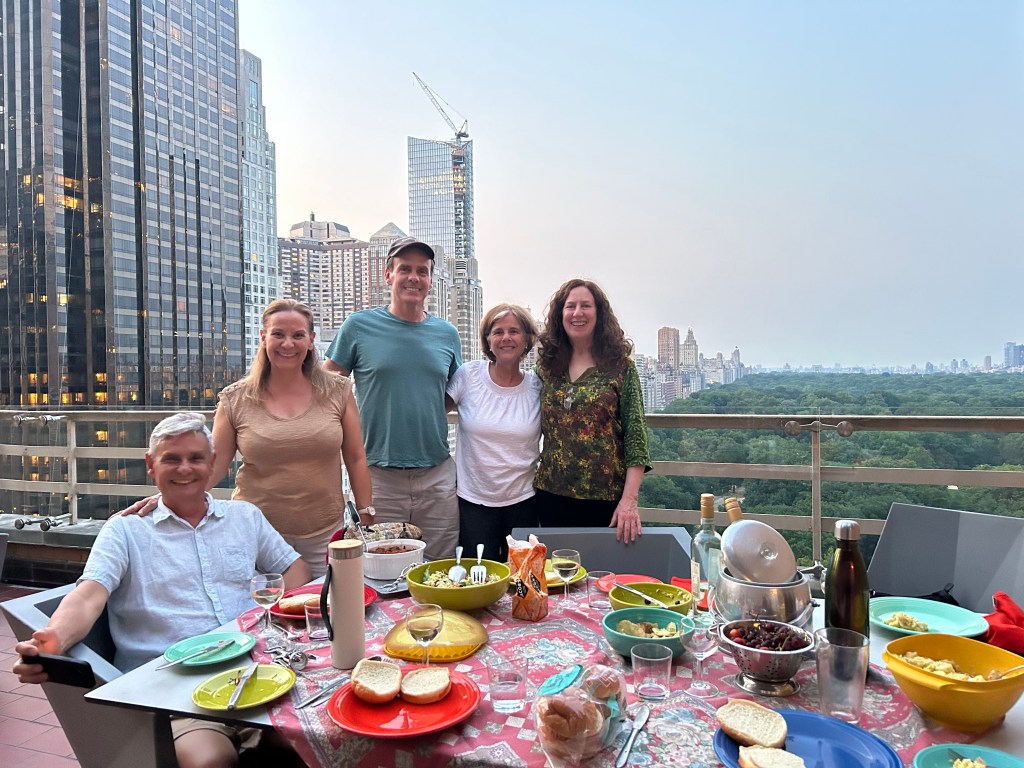
Dinner overlooking Central Park, NYC

Hawaiian Night at family reunion, June 2024

Spring Broke

With a nod to my friend Amy, I appropriate her lament for teachers on Spring Break this year. I didn’t have any money to spend on a trip to the Bahamas or Hawaii, which has turned my holiday into an inexpensive, productive, and fun week.

Being broke has an upside. I reached out to friends I haven’t seen in ages – including Amy, who I ran into while walking her dogs in Wheaton Regional Park. Then I met her for drinks at a sponsored event that several local elected leaders attended. Free food! Great way to catch up on each other’s news. We also shared our diverging answers to the question, “How are the kids these days?”

The kids are definitely better this year than last, but a lot of my seniors simply didn’t submit the in-class essay, the biggest grade of the marking period, even though they were given plenty of time, advance notice, and open-notes formatting. Several sat in class for two days with their heads down instead of writing. Amy teaches middle school and has different issues – disrespectful behavior from dysregulated students and social promotion policies that thwart any efforts to hold students accountable for showing what they’ve learned.

It’s been rewarding to cross items off my enormous To Do list. Dentist appointment, filing taxes, dealing with my son’s car insurance and maintenance ($$$). I’ve also spent a lot of time on school work: creating materials for a MCPS curriculum-writing project, meeting with that team, and grading student assignments. But the most rewarding aspect of my Spring Broke has been reconnecting with friends. Cherry blossoms, museums, and hiking don’t cost much in the DC area. I feel so lucky to have friends who like those activities, too.

A long-term sub in my department was asking about entering grades in Synergy (our online grading platform), and when I showed her what I do, she responded, “That’s so much work!” With just two more days left of spring vacation, I turn to all the unfinished tasks. Fortunately, my stay-at-home plans this year have allowed me to save money, make huge progress grading essays, and share many little fulfilling conversations that will sustain me as we push to the end of the school year. Oh! And I got to see some provocative art!

The Motivational Speech

I was flattered that L.J. surreptitiously recorded my farewell speech to Period 3 Honors English 12. I’d just signed a dozen yearbooks and stumbled into the perfect metaphor: a rocket! Our school mascot is a Ritchie the Rocket, so I said something about using high school as a launching pad while soaring to new heights, with rocket power fueling your rise to success. I know that the metaphor was corny, but I had their full attention.

In Period 6, I read Oh, The Places You’ll Go! in its entirety. Not one student glued their eyes to a cell phone. Nobody asked to go to the bathroom while I read in my best teacher voice. You have brains in your head, you have feet in your shoes. You can steer yourself any direction you choose.

Dr. Seuss is out of favor these days. But his words fit the expectations of the moment. Something happens to seniors in their last week of school. A sudden realization that This. Is. Final. The fear, the sadness, the excitement. For 23 years, I’ve been saying good-bye to students at the end of the school year. I know my role.

This year, however, we had briefly reversed roles. Seniors wrote and delivered their own motivational speeches. We watched some model orations: a wedding toast, a graduation speech. I provided a graphic organizer, a rubric (below), and a deadline. I got some of their best work all semester.

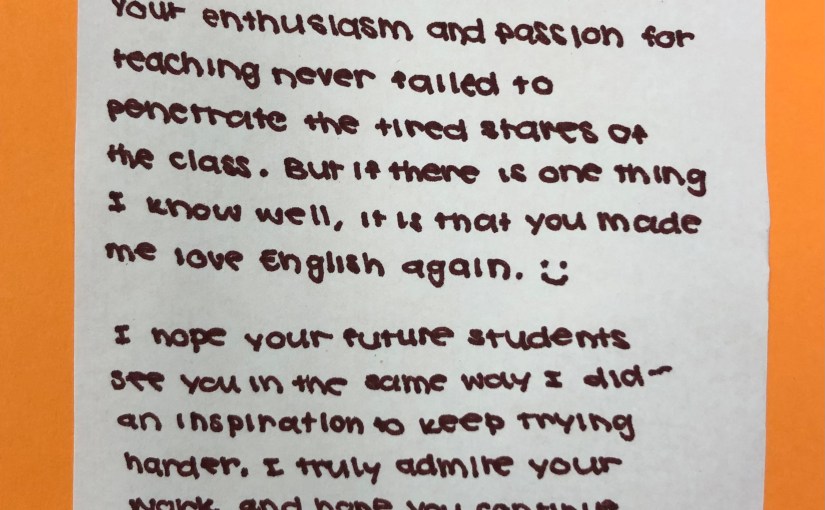
Maybe that’s why some of their final thank you cards brought tears to my eyes on the last day. I choose to believe that the self-reflection imposed by our final English 12 assignment became internalized, that students rose to the occasion. We tend to think that students are disengaged, but they pay attention to every nuance and they have something to say.

The Class of 2023 has brought back hope and a positive attitude.

A motivational speech will often end with a positive quote. Fueled by Rocket pride, my students will join the high fliers who soar to high heights and be the best of the best! I hope my words will give them a boost. I know theirs have certainly boosted me.

The quiet drop outs

It’s not shocking that the December 30th deadline for confirming my National Board Certification candidacy has forced me to ask the right questions. If I’m co-teaching two sections of Honors English 12 and teaching solo two others, which class would be best to film for Component 3? Or should I use my 7th period ELD Seminar class that has only 10 students? Should I certify in English Language Arts (the subject I’m actually teaching) or English as a New Language (my career specialty)?

It turns out that I have to scrap the videos I’ve recorded, delete the written commentary, and wait until next semester when my new schedule includes 51% English Learners in a sheltered Honors English 12 class. Teachers have to pivot all the time. Good thing I checked before spending the rest of the school year completing unscorable components. One thing, however, has come out of this frustrating process that I cannot dismiss.

The data I’ve collected on my students may not be valid for National Board Certification, but it deserves some written commentary. So here it is.

Out of the 106 students in my four classes, 30 have missed 20 or more days of instruction or they have stopped coming to school altogether. Some have withdrawn from school officially, some have switched to “credit recovery” classes online, and one had a baby. Many English Learners are working full time and miss class because they’re exhausted. But where are the other students? Why aren’t they coming to school?

Over and over again, I try to contact the students on my roster. I call home, I send an email to the counselors, administrators follow up, kids get referred to the Wellness Center, I involve the Parent Community Coordinator or the Bilingual Counselor. Some will show up once a week or two. My school and school district have wonderful resources, fully employed. But why aren’t these students coming to class?

Teachers and school staff understand why. These students are suffering from enormous mental health challenges as a result of the pandemic. It’s not just a disengagement. This year’s seniors spent the spring semester of their freshman year and 90% of their 10th grade year online. These are crucial formative years, where adolescents naturally break away from their families and seek peer friendships as they develop independent identities.

Schools have made incredible adjustments to accommodate student needs. But we must keep asking the right questions. How can we better address the experiences of high school students whose natural growth process was stunted? What new programs or new staffing can we put in place to support the whole child? School is not just for academics. We’ve known that for a long time. Why has it taken a public health crisis to begin to address this?

During the pandemic, articles about the “great resignation” began to appear. Workers seeking better jobs jumped at new employment opportunities. Now we hear about “quiet quitting,” where workers are opting out of any extra tasks outside their primary job duties (in the teachers’ union, we call this Work to Rule). High school students are paralleling what companies and employers are seeing in the workforce.

Seniors are doing the absolute bare minimum to meet graduation requirements. It’s a huge problem in the classroom when 30% of the students missed the intro lesson and we can not make progress. I have to completely re-think discussion groups or project-based assignments that require peer collaboration. What social-emotional skills are they also missing?

It’s a quiet drop out crisis. The soft skills that today’s teens will need to be successful members of society are not developing normally. We can help them if every school, every district, and every state begins to ask the right questions, gather data, and reflect on possible solutions. It would help to have a deadline.

Hamlet and the Class of 2022

Appearance vs. Reality. Anxiety. Mistrust.

The themes of Hamlet could be taken from today’s headlines. Or maybe from our students’ social media posts. When we asked Honors English 12 classes to find elements of the play that are valuable and relevant for today’s young people, many chose to make a personal connection to Hamlet’s disturbed state of mind. Who can blame them? The mental health crisis among teens today is well documented and serious.

Like Hamlet, this year’s seniors have experienced plenty of disruptions in their lives: school shootings, toxic political discourse, the #MeToo movement, Black Lives Matter, and two years of pandemic schooling. Hamlet spends half of the play depressed and brooding. Then in a moment of rage he lashes out at the man behind the curtain, killing Polonius instead of his evil uncle, the king.

Fortunately, student fights in the hallways don’t usually end in murder. Most school districts saw a huge uptick in violence as students returned to school buildings in the fall of 2021. School police officers had been removed in response to the BLM movement and administrative teams were overwhelmed. Something was definitely rotten in the state (of Denmark), and our leaders were very slow to recognize it.

In the classroom, however, we see almost the opposite effect: lethargy. Here we are, two months from graduation, and it’s almost like the entire class of 2022 presents with Ophelia syndrome: they’re going through the motions of writing an essay, but waiting for authority figures to tell them what to think. I don’t truly believe that, but wonder how much their social-emotional development was stunted by 18 months spent going to school from a corner in their bedrooms? Is that why they identify so much with Hamlet?

Teachers continually try to find ways of connecting Hamlet to the real world. Here and here are some of the best ways that is being done this year.

Polonius counsels his son Laertes before he heads back to university. “To thine own self be true,” he tells him.  What does that even mean for the Class of 2022?