Co-teaching: A Dance of Diplomacy

I first met Teacher S over Zoom the year my district went 95% virtual and leadership rolled out a new instructional model for ESOL students (back then, they were still called ESOL students, instead of the alphabet soup of acronyms we use today). Under the extreme circumstances of the pandemic, it was a pleasure to interact professionally with another teacher regularly. Mostly I followed along and did pull-out groups in the Breakout room, where I could provide additional language support. I enjoyed the camaraderie of having someone to help me figure out this totally new way of teaching.

Once back in the building, co-teaching took on a different tone. Instead of equal-size Zoom boxes, one of us now had a classroom and one of us didn’t. Teacher S filled the shelves with their books and knick-knacks, the walls with their colorful posters, and rugs and furniture brought in from their house. I had a shared desk in a shared office in the ESOL Department (now called the ELD office = English Language Development). 

Only one teacher’s name appeared on the electronic gradebook and the Canvas classroom tile. That teacher received all communication from parents, counselors, and the Main Office. I was lucky if they remembered to share pertinent information about students, new policies or schedule changes. I’d been erased.

All the ELD teachers were plugging in to the content teachers’ classes, no matter their level of experience, expertise, or comfort level. That first year, I had five different co-teachers. I had to lug my cart through the hallways, moving from room to room to room, struggling to get past clusters of students before the next bell rang. 

With each teacher, I had to negotiate the space – who would stand where, who would deliver the lessons, where would I put my things? With each teacher, I had to negotiate who would prepare which lessons, who would deliver the lessons, and who would grade the student work.  I had to tread carefully with each teacher, giving advance warning that I was an interrupter, and would that be okay? Sometimes I would need to paraphrase, repeat, or clarify information for ELD students. Sometimes I would need to modify handouts so the students learning English could understand what they were reading. Each interaction was a careful conversation. 

Today, that’s pretty much how co-teaching runs for secondary ELD teachers in MCPS. We’re thrown together with other teachers and it’s on us, the ELD teachers, to adapt to the content teacher’s style, their preferences, their classrooms. If we’re lucky, our ideas and teaching style mesh perfectly, and all the little decisions we make every day will help students thrive. If not, it’s a constant negotiation of every single interaction that takes place.

Diplomacy involves give and take – that I understand. But why does it always seem like the ELD specialist has to give something up? 

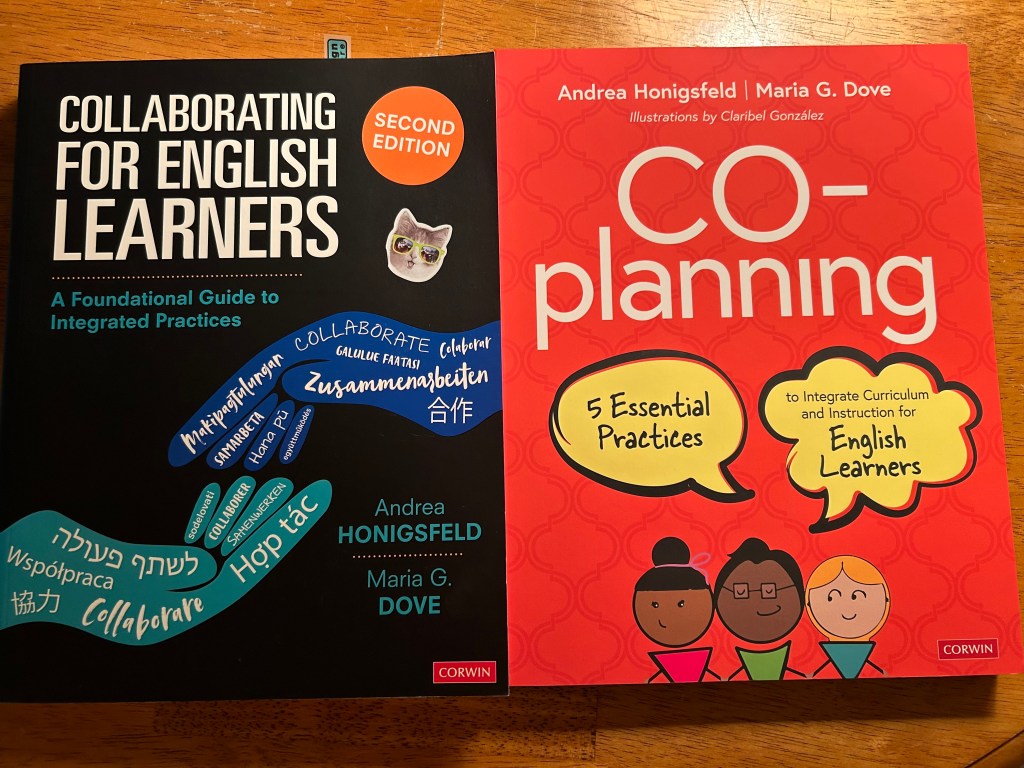
According to Collaborating for English Learners, by Andrea Honigsfeld and Maria G. Dove, teachers should “be on an equal footing” and all members of collaborative teams need “equal time to contribute to team efforts.” 

In their updated book, Co-Planning to Integrate Instruction for English Learners (2022), the same authors write “Co-planning requires teachers to change not only what they do but also how they think.” This is a critically important comment. “For co-planning to work, teachers must endeavor to share their beliefs, understandings, opinions, and convictions with fellow teachers and be open to incorporating unfamiliar ideas into their class instruction.”

It takes a certain type of professional to be flexible enough to incorporate unfamiliar ideas into their instruction. Most teachers are control freaks. Most teachers are used to being the lone voice of authority in front of children. Most are not willing to cede any territory without a fight. Or at least an exhausting series of conversations.

It’s only the third week of school, and I’ve been doing the dance of diplomacy since Pre-Service Week. I’m tired. I’ve lost my temper with my co-teachers; I’ve gotten on their nerves. I’ve succeeded in some important ways, and I’ve caved on others. 

Once the students enter the room, we smile and carry on. 
Rhythms of virtual teaching

For nineteen of the past twenty years, I have woken up at 5:00 am every school day. By 7:00 am I was in my classroom welcoming early students who needed a place to put their heads down or eat breakfast until the bell for first period rang. High schools in MCPS usually start at 7:45. Not any more, not with Covid-19 keeping us all connected by computer. Most of my professional life has been measured by bells ringing, 10-week marking periods, testing schedules, holiday breaks, and seasons. This year has disrupted the usual rhythm and made me much more aware of what I have lost, and what I have gained. 

My schedule is still segmented into hour-long periods and 10-week quarters, but there are no bells ringing. Just my alarm, which now goes off at a reasonable 6:30 am. This is how I begin my day: yoga stretches, shower, walk in the neighborhood, coffee and breakfast, read emails & news, and talk to my husband. My duty day starts at 8:15, but virtual classes don’t start until 9:00. I begin by checking online work platforms, chatting with co-teachers, checking which students handed in assignments the night before, and planning for the day’s instruction. 

A lot of people don’t understand that teachers working remotely are still teaching. Here’s my weekly schedule:

I teach four hours a day, four days a week, live on Zoom. On Wednesdays, we have meetings from 9:00-10:30, then meet with small groups of students – if they show up – for check ins. My camera is on, the lesson uploaded, and we deliver instruction to groups of 28 at a time. I say we because high school ESOL teachers have moved to a co-teaching model this year, so I support 6-10 English Language Learners in Honors English 10 and Honors English 12. There are no regular English classes (we’re all above average in MCPS).

In our district, we have to record every lesson, which is posted to Canvas (our platform), and self-destructs in 72 hours. Students are not required to turn on their cameras so we teach to a screen of black tiles with the student’s name written across it in bold, white Arial. With so many students and two teachers, everyone has to keep their microphones muted, or the feedback noise distorts our voices. Fortunately, we have the chat feature, and high schoolers know how to use it. Some days we’re lucky if we get even that much participation. We put students in breakout rooms with instructions to discuss a reading, and when we pop in on them, black-tiles and silence. I really miss seeing their faces and hearing their voices.

Co-teaching has been a huge adjustment for me, since every lesson takes twice as much planning and I work with four different teachers across two grade levels. The curriculum is new and has to be pared down to the bare minimum. We are getting the revised curriculum materials just a week before delivering instruction, and there isn’t sufficient time to prepare alternate readings or provide appropriate grammar and language support for English Language Learners during the whole-group meeting. With some of my co-teachers, I play an active role in class. With others, I am a silent observer delivering ESOL support through Zoom chat. Focused Intervention groups are put in place to help the at-risk students, but the neediest ones never show up at that designated time. 

And yet, we have made it through the end of November somehow. What seemed unsustainable in early September has become routine. I’ve learned how to engage in careful dialogue with my peers about instructional materials and methods of delivery. They have learned how to simplify their assignments and the importance of using visuals when speaking. I’ve reached out to struggling students – not just those learning English – and gotten to hear the voices of parents, guardians and the students themselves. Most are really appreciative to have a phone call and a compassionate listener. 

My duty day ends officially at 3:30 pm but I am never off-duty in a virtual world. I constantly check email, Synergy mail, Canvas mail and platforms where students might have questions or submit late work. Every two weeks, I follow up with students who have zeros – sending explicit instructions with live links of how to complete the assignments. Where co-teachers are comfortable with shared responsibility, I grade papers and make comments. I create rubrics and slides to share with colleagues. It’s nonstop, but it’s rewarding. Most students are showing up. Most students seem to be okay.

This year, I have gained a huge appreciation of the natural world around me. I am so lucky to have rowing (even though the season is officially over), and I’m lucky to have the woods near my house. Every morning, I walk through the neighborhood or hike down the path. I listen to the birds, I breathe in smells of damp leaves on the forest floor, I focus on the seasonal changes around me, and enjoy this rare moment to walk in the early-morning sunlight before school starts.