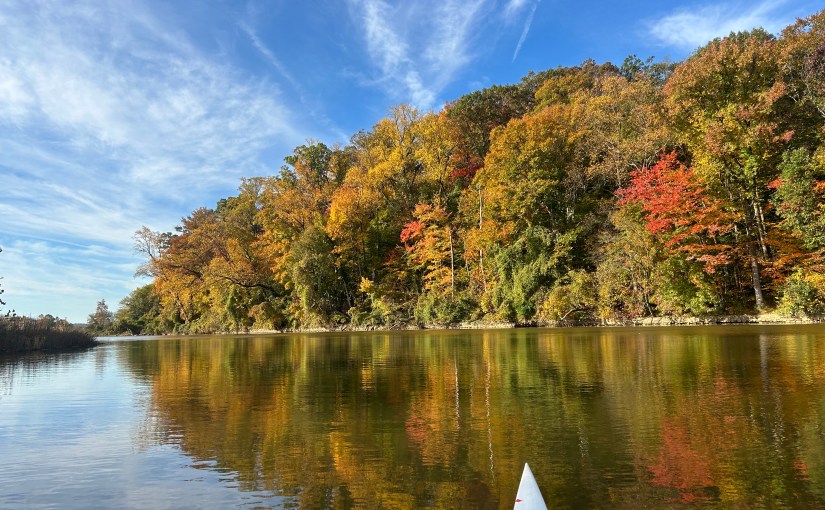
Two days after the presidential election, I went rowing on the Anacostia River in Washington DC. Our season usually ends after the first weekend in November, so it was a last-hurrah kind of moment before the weather grew too cold. A poignancy more pronounced by my extreme dismay over the election outcome.
Trees along the river glowed red, gold, and various shades of green. A perfect blue sky reflected like a postcard image in the water. I rowed downriver backwards, two ten-foot oars sticking out on either side of the narrow racing shell, and considered how lucky I was to have this sport, this river, this scenic beauty, especially on a day when, like so many others, I desperately needed solace and release.
Near the docks, a dredging barge lay in wait, ready to suck the sludge from the bottom of the river so the Bladensburg Waterfront Park harbor could still host the large Anacostia Watershed Society pontoon boats, their fleet of canoes and kayaks, and the seven different private rowing clubs that launch from the park.
Muckraking. They were literally muckraking.

The dredging crews have to wait until the end of the season, when high school rowing teams are finished for the year. And before river creatures begin their winter hibernation.
A transitional time in nature and a transitional time in our country.
I turned to starboard and steered clear of the enormous underwater boom marked by large orange buoys. Further downriver, I navigated through a series of Surface Water Passive Samplers that suddenly appeared (I only learned later that they were placed in the river by the Department of Energy and Environment for a multi-year being undertaken by the District to mitigate toxic sediments (https://restoretheanacostiariver.com/). Great work, but a huge hazard for boaters if improperly marked.
At the river bend just upstream from the National Arboretum, I gasped in awe. Such spectacular beauty could not be captured; I pulled my phone from its ziplock pouch to snap a photo anyway. The wall of colorful trees against a bright blue sky soothed my eyes. The rhythm of rowing calmed my nerves. They may have won the election, but they can’t take this away from me, I thought.
“How far are you rowing?” I asked Bob, who often rows a single at the same time as me. We’re the Odd Timers, a rag-tag group that goes out whenever we can get a few people together.
“Until I forget the worries of today and prepare for the worries of tomorrow.”
I probably need to keep rowing for four more years, I thought.
I turned around just above the Langston Golf Course and headed back to the dock. The dredging barge was still there, clearing the channel to make it navigable for the rest of the year. Then my oar hit a rebar post sticking up with no buoy or flag to indicate a hazard. It could have easily pierced my rowing shell.
I’ve been thinking about all the obstacles and chaos coming our way starting January 20. The president-elect promised to “drain the swamp.” But when you actually remove the mud, it clears the way, opens new channels, and allows water to flow smoothly downstream.
I predict a lot of metaphoric dredging booms and unmarked hazards in our future. We will all have to navigate through the muck of this new administration. When their time is over, the muckrakers will clear the path and natural beauty will prevail. Both on the river and in our country.

 Eva K. Sullivan