I live less than 10 miles from the White House. It’s hard not to feel demoralized by the astounding changes to the world around me since January 20, 2025. Federal workers laid off, the decimation of vital U.S. government agencies, blatant homophobia and misogyny masquerading as policy, and the dehumanization of immigrants. I’ve spent part of the year in mourning for the America I once thought I lived in.
However, the “sickening moral slum” of this presidency is countered daily by the activism of friends, colleagues and total strangers. As 2025 wraps up, I choose to focus on things that make me hopeful.
Fellow rally-goers. I’ve been to No Kings Day demonstrations, marches for immigrant rights, and sing-alongs in front of a courthouse. Every time, I am warmed by the spirit of civic engagement. I am proud to live in a community where we are (still) free to assemble in public and express disagreement with our government.
Musicians. I have joined so many sing-alongs, karaoke nights, protest-music nights, and other music groups that I feel like a groupie. Musicians carry the spirit of our times like few other artists. They can bring a group together in a way that uplifts the entire community in real time.
Colleagues. Teachers are the most amazing group of people. And teachers of immigrant students have a special place in my heart. I work in a school with an enormous ELD department (formerly ESOL). Even as the students stop coming to school (fear of ICE raids) and attendance is at an all-time low, my colleagues persevere. They help the students who show up and reach out to those who don’t. We support each other in the office before school, during lunch, and after school. In a job that can be emotionally draining, my colleagues make it better every single day.
So, as the meme says, have the best year. My resolutions for the new year are exactly those shared in this image.
My advice for the New Year: Get outside every single day, no matter the weather. Join a group. Honor your commitments to yourself.
Wishing you the courage to pursue the activities that give you joy.
The end of rowing season always brings feelings of relief and melancholy: so many days, so many hours of rowing, driving to the boathouse, planning workouts, carrying boats down to the dock, washing shells after practice, breaking down the motor launch, chatting at the park with others who share a love of the best sport in the world. I miss the exhaustion already, and don’t know how to fill my extra time.
I finished the Sunday crossword puzzle two weeks in a row, and I’ve learned a couple of new tunes on my recorder, ready to join the Celtic Ensemble again. I’m loving my new crime thriller audiobook (Louise Penny’s Inspector Gamache is so much fun). My son and I went shopping for winter coats together. We had Thanksgiving at a friend’s. My life is full. Yet I find myself researching winter workouts when I should be planning next week’s lessons for school.
I never thought I’d get pulled back into coaching teens again, but that’s exactly what’s happened. I love it and dread it at the same time. I love teaching new rowers the protocols and technique. I love watching young people get excited about doing hard physical work for the first time, especially when they thought they couldn’t. I love the playfulness they bring to the team, even when my reprimands about horseplay brought the wrath of parents.
It’s a rebuilding year with a small high school team. My job is to keep it fun, to teach the sport, and bring everyone back in the spring to start all over again. And bring a friend.
Seasonal transition periods usually make me more reflective, and this one is no different. Should I retire and become head coach again? For real? Should I finally downsize and move out of this large home? My older son recently got engaged. This would be a perfect grandmother house, if that’s in the future. I can put off that decision for now. I still have a rewarding, full-time teaching job. I believe I still make a difference.
Fellow masters rowers have started the Holiday Erg Challenge, a Concept 2 virtual rowing regatta, where the goal is to row 100K between Thanksgiving and Christmas. This is a regatta for people who don’t embrace the liminal space of transition like I do. They gather in the 28-degree dawn at the boathouse, ergs lined up in the darkness. They’re rowing 10K on the machines every day. I planned to join them, but sleeping in until sunrise and home-brewed coffee in my pajamas just called too loudly this year.
Tomorrow it’s December and we start the high school winter workouts three days a week. I’ve enjoyed my down time, but it’s time to embrace the crazy-busy again.
It’s the last day of Marking Period 1. English teachers are dressing as idioms for Halloween. I’m supposed to be a copy cat but I can’t find my kitty ears from last year. With a slight sore throat and headache, I have no energy to go digging through the family costume box before school. I’ll just wear a black mask and meow if anyone asks what I am today.
The everyday costumes that I see walking the halls of my extra large high school (2800 students) always put a smile on my face. Some girls with full, ready-for-my-close-up makeup at 7:45 am, carefully curated outfits with big fuzzy boots. Mostly a lot of hoodie sweatshirts and comfortable pants.
Teen backpacks also make me smile. Often adorned with labubus dangling from key chains, they feature little-kid cartoon characters: Lilo & Stitch, Lightning McQueen from Cars, Elsa from Frozen, Teenage Mutant Ninja Turtles. Worn without irony.
I don’t understand it. Six seven. Whatever. A reminder to just lighten up.
It’s the first week of summer break, and I’m doing what many teachers are doing: making medical appointments, washing clothes, cleaning closets, planting petunias, and catching up on all the ignored chores that I have no time for during the school year.
After six years at Richard Montgomery High School, I’ve packed up my classroom, said good bye to students and colleagues, and posted final grades. I’m transferring to another high school in the fall. A school closer to my home with a bigger population of English Multilingual Learners. A school where, hopefully, I can soar to new heights.
I make this transition with mixed feelings. The experience of working at “a good school” is seared into my memory. In the morning, kids hold the door open for teachers as we enter from the parking lot. When disruptive students push each other in the halls, I yell, “Hey, no violence!” They apologize sheepishly and walk away. Because at RM my tone could be light – students were just exuberant the last weeks of school.
I will miss the United Nations roster of names in my classes. Students from 39 different language backgrounds. Blonde students from Europe. Black students from West Africa. Afghani students with powerful stories. Regular kids who have a job after school, drive their own car, or play on a state-champion sports team. Students who occasionally question my assertions (they’re paying attention!). Students who say thank you.
I will miss the principal fly-bys, and our micro relationship-building sessions. The conversations with my English Department colleagues as we pass in the hallways or wait for the bathroom. My fellow ELD teachers who helped propel me through the worst school year of my life. The one-to-one chats with teachers from other departments who sought me out as MCEA union rep. The committees I served on. Working with the Career Coach or the senior class sponsor. Attending Prom.
All these memories empower me, but I know it’s time to move on. I appreciate everything that I’ve learned at RMHS and the support that I’ve been given. I’m ready for a new challenge.
Sometimes a Rocket has to lose its boosters before it can reach higher altitudes.
Over the past couple of months I’ve interacted meaningfully with different groups of friends: friends I’ve known for decades, friendly neighbors, fellow rowing enthusiasts, and brand new acquaintances. Almost invariably, our conversations digress to politics. It is an election year, after all, and we live a few miles from the White House.
“We live in a bubble here in the DC area,” they say. “Away from the big cities, Trump is still very popular.” National politics is our local politics, and we all have opinions.
“Democrats are losing the culture wars,” they say. “By focusing on LGBTQ-plus issues, they’re losing mainstream Americans.”
“So you don’t support LGBTQ rights?” I’ll challenge.
“Of course I support the rights of trans and LGBTQ people!” they huff indignantly. “But I draw the line at all the pronoun stuff.”
The first time it happened, I looked on in disbelief. My liberal, progressive DC friends can not handle the reality of LGBTQ+ rights, no matter what they profess.
Let me tell you up front that we are all in our late 50’s or 60’s. Older adults. Many of my friends are retired. I still work full time teaching high school.
“They is a plural pronoun; it should not be used as a singular.”
“Right! And putting the pronoun in the signature is so ridiculous!” they say. “Why do we need that? It’s usually so obvious if you look at the name!”
I felt this way seven or eight years ago. As an English teacher, I struggled mightily with this issue – especially with English Language Learners, who need to learn the rules of grammar.
Then in 2016, my first trans student began their transition right in front of me. She became he. He became they. I kept messing up their new name and using the dead name, each time apologizing for the brain fart.
That student’s name in my online gradebook was a very girly name. This was before the MCPS policy allowed students to determine the name that appeared on teachers’ rosters, before we asked for their pronouns in the first week of school, before my direct supervisor signed her name Mx, before one of the first LGBTQ studies classes in the district was held in my shared classroom and I saw first-hand what it meant to be a student from a traditionally-marginalized background.
The face that stared at me with bright blue eyes was a girl’s face, now with short hair and a crocheted rainbow hat. The pudgy body slumped in giant rainbow t-shirts. Combat boots. Since then, I think I’ve had a trans kid in my classes every semester.
“But it’s so disrespectful of their identity to use the wrong pronoun! It’s like purposefully mispronouncing someone’s name because you can’t be bothered to learn it!” I tried the direct approach with my friends. “Or using a detested nickname instead of their real name.”
In MCPS, students are allowed to self-identify their gender as male, female, or X-Nonbinary. They are allowed to use bathrooms and locker rooms “in alignment with their consistently asserted gender identity.” I support this. My friends do, too. Or at least they say they do.
So why do my older DC friends draw the line at the pronoun thing?
Back in the early 70’s our parents balked at calling a woman Ms. instead of Miss or Mrs. We argued that it was nobody’s business – especially when first meeting a young woman – if she was married or single. Gradually this honorific gained widespread use, and now it’s a normal form of address.
Maybe that’s the argument I need to use with my friends. However, I do not feel qualified to take on this issue. I’m not LGBTQ; I do not have any immediate family members who identify this way, but I am an ally. I have a unique perspective that I feel compelled to share.
Now MCPS promotes inclusive LGBTQ curriculum, staff training, and Pride Town Halls. I’m proud to be part of a progressive school district that is at the forefront of affirming the rights of gender non-conforming students. Even using that terminology is something I did not do eight years ago.
According to a recent Gallup Poll, only 7.1% of Americans identify as LGBTQ+ but among Gen Z kids, it increases to one out of five. My students took a poll and thought it was almost 30 percent! I think our perception of this issue is strongly influenced by who we surround ourselves with. I am privileged to work with young people every day and can sometimes see the world a little bit through their eyes.
This is my chance to influence my Baby Boomer peeps. “Be kind,” an older colleague reminded me when I presented my case to her. “They don’t work with teens every day, and they probably just don’t know how important it is.” I’ll go with that.
This blog is my first stab at addressing the often-confusing, ever-changing language around gender identity. I hope I haven’t messed it all up.
With a nod to my friend Amy, I appropriate her lament for teachers on Spring Break this year. I didn’t have any money to spend on a trip to the Bahamas or Hawaii, which has turned my holiday into an inexpensive, productive, and fun week.
Being broke has an upside. I reached out to friends I haven’t seen in ages – including Amy, who I ran into while walking her dogs in Wheaton Regional Park. Then I met her for drinks at a sponsored event that several local elected leaders attended. Free food! Great way to catch up on each other’s news. We also shared our diverging answers to the question, “How are the kids these days?”
The kids are definitely better this year than last, but a lot of my seniors simply didn’t submit the in-class essay, the biggest grade of the marking period, even though they were given plenty of time, advance notice, and open-notes formatting. Several sat in class for two days with their heads down instead of writing. Amy teaches middle school and has different issues – disrespectful behavior from dysregulated students and social promotion policies that thwart any efforts to hold students accountable for showing what they’ve learned.
It’s been rewarding to cross items off my enormous To Do list. Dentist appointment, filing taxes, dealing with my son’s car insurance and maintenance ($$$). I’ve also spent a lot of time on school work: creating materials for a MCPS curriculum-writing project, meeting with that team, and grading student assignments. But the most rewarding aspect of my Spring Broke has been reconnecting with friends. Cherry blossoms, museums, and hiking don’t cost much in the DC area. I feel so lucky to have friends who like those activities, too.
A long-term sub in my department was asking about entering grades in Synergy (our online grading platform), and when I showed her what I do, she responded, “That’s so much work!” With just two more days left of spring vacation, I turn to all the unfinished tasks. Fortunately, my stay-at-home plans this year have allowed me to save money, make huge progress grading essays, and share many little fulfilling conversations that will sustain me as we push to the end of the school year. Oh! And I got to see some provocative art!
It could be worse. I have a roof over my head, a job, a reliable car. My neighborhood is a steady source of comfort and fun, whether I’m walking the hills after school or meeting up for a book club discussion. But my coping skills in the face of my son’s disability are undoing me, while all the promised supports remain unfulfilled.
Since his father left two years ago, my adult son – let’s call him Xavier, after the name I wish I’d given him at birth – has fallen into a deep, debilitating depression. On top of his autism spectrum disorder, this has been a devastating turn for our newly-configured family of two. I’ve learned to tiptoe through the house after school because his night-day reversal makes it impossible for him to maintain a normal routine. When I smell sausage cooking at 3 am, at least I know I’ve got a few hours before a wellness check is needed.
For two years, I have launched hundreds and hundreds of phone calls, emails, and in-person visits to agencies and individuals designed to help me deal with Xavier’s rages, poor eating habits, insufficient exercise, medication management, and lack of meaningful work. I’ve kept track of every contact on narrow-ruled notepads.
He’s got full eligibility for Developmental Disabilities Administration (DDA) services, and is now on their Wait List. Because he qualifies, a service coordinator has been appointed to help navigate the system. In her six years on the job, she’s never seen anyone move off the Wait List.
I’ve applied for Supplemental Security Income (SSI) benefits through the Social Security Administration. They needed an updated neuro-psychiatric evaluation, which occurred over several days and cost me $3000. I sent in supporting letters from therapists, doctors, and licensed clinical social workers who had worked with him over the years. A worker in DC was handling the SSI application because, she said, Maryland was backlogged by 20,000 cases. She told me, “pack your patience.” SSI turned him down. Now I’ve appealed the decision and contacted a lawyer.
The Division of Rehabilitation Services (DORS), a Maryland Department of Education agency, has allotted Xavier full support status. He met with a vocational specialist there and completed the three-day career assessment inventory they recommended. Then she retired, and it took months to get another appointment. Appointments in most places occur between 9:00 am and 5:00 pm. Xavier could not get out of bed for the next few appointments.
I’ve put Xavier on the county wait list for HOC housing, found another agency that allotted 140 hours of respite care. So far, he’s slept through every appointment. I called his insurance provider. Immediately post-pandemic it was impossible to find a Medicaid-funded therapist with availability.
Dozens more phone calls and emails got him into a Medicaid-funded wellness center, where he got monthly therapy with a practitioner he liked. Then that guy retired. The new guy has not earned Xavier’s trust or my respect. But at least Xavier got an updated anti-depressant prescription. Who knows if he’ll actually take the medicine.
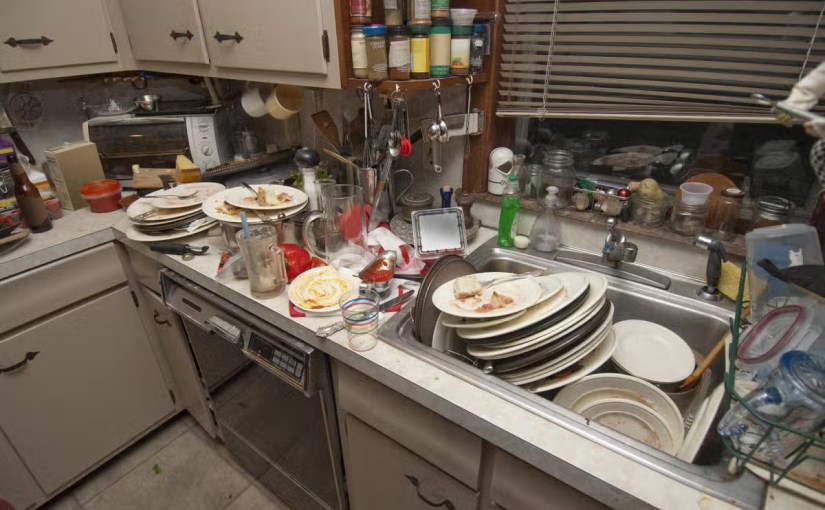
In the meantime, I found a family therapist that could work with my insurance. They live in another time zone and can do telehealth therapy with us at 7:00 pm. I have to sit at my computer ignoring the dishes piled in the sink, the cat vomit on the carpet, and Xavier’s electronic pile up in front of the TV. He’s forgotten to put out the recycling again, and the blue bin is overflowing. They suggested I reset my expectations.
After my husband left, I cut the cleaning lady down to once a month because I couldn’t afford it. I mean, that’s what I told her. But the truth is that the whine of the vacuum cleaner sent Xavier into such a rage that he punched a hole in the ceiling. I had to ask the guy who cuts my grass to stop using the leaf blower outside because the noise disturbed Xavier’s sleep. At 3 pm.
When I traveled to Uzbekistan for work in June, I arranged for Xavier’s brother to come down from New York and stay with him, then take a train together to their father’s in Maine. I hired a teen to look after the cat, and a neighbor to keep an eye on the house. I didn’t think Xavier could function in the house unsupervised. At the time, he was off his medication completely. I’d contacted the crisis center to find out how they would deal with someone on the autism spectrum. Before my trip, I set up a special needs trust in case something happened to me.
What happened is that Xavier refused to leave the house. He and his brother had a major fight, and his brother went back to New York. There’s a nine-hour time difference between Maryland and Tashkent, and I was fielding phone calls from both boys, my ex, and my lawyer at odd hours. Then going off to teach English with a smile on my face. I should have called the police. Then maybe my DDA Priority Category Assessment change would go through.
My mortgage increased by $500 per month in August and it’s clear we can no longer stay in this lovely house together. So now, while working full time as a high school teacher, managing Xavier’s appointments (and moods), I will have to get this large house ready to sell by myself. You may ask where his father is in all of this. He’s still paying for half of the house. Thank God. It could be worse.
I’d like to say I’m waiting for something better to come along, but I suspect things have to get far worse before we’ll get any help.
I was flattered that L.J. surreptitiously recorded my farewell speech to Period 3 Honors English 12. I’d just signed a dozen yearbooks and stumbled into the perfect metaphor: a rocket! Our school mascot is a Ritchie the Rocket, so I said something about using high school as a launching pad while soaring to new heights, with rocket power fueling your rise to success. I know that the metaphor was corny, but I had their full attention.
In Period 6, I read Oh, The Places You’ll Go! in its entirety. Not one student glued their eyes to a cell phone. Nobody asked to go to the bathroom while I read in my best teacher voice. You have brains in your head, you have feet in your shoes. You can steer yourself any direction you choose.
Dr. Seuss is out of favor these days. But his words fit the expectations of the moment. Something happens to seniors in their last week of school. A sudden realization that This. Is. Final. The fear, the sadness, the excitement. For 23 years, I’ve been saying good-bye to students at the end of the school year. I know my role.
This year, however, we had briefly reversed roles. Seniors wrote and delivered their own motivational speeches. We watched some model orations: a wedding toast, a graduation speech. I provided a graphic organizer, a rubric (below), and a deadline. I got some of their best work all semester.
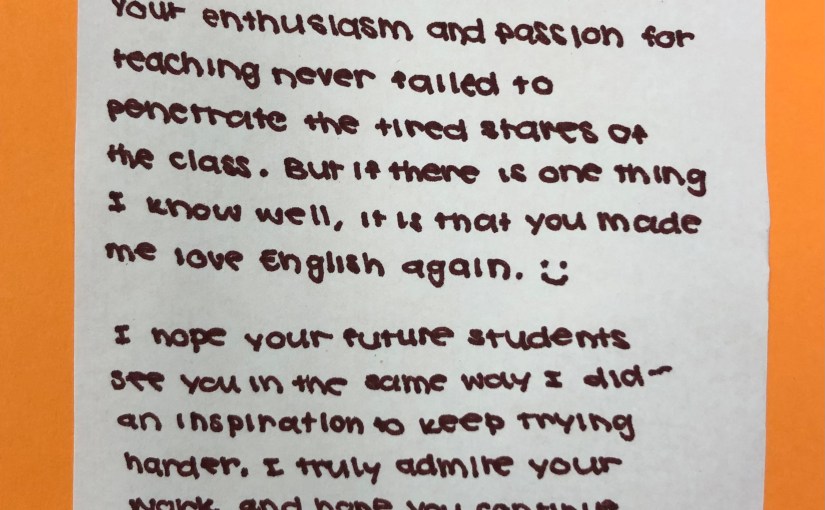
Maybe that’s why some of their final thank you cards brought tears to my eyes on the last day. I choose to believe that the self-reflection imposed by our final English 12 assignment became internalized, that students rose to the occasion. We tend to think that students are disengaged, but they pay attention to every nuance and they have something to say.
The Class of 2023 has brought back hope and a positive attitude.
A motivational speech will often end with a positive quote. Fueled by Rocket pride, my students will join the high fliers who soar to high heights and be the best of the best! I hope my words will give them a boost. I know theirs have certainly boosted me.
The themes of Hamlet could be taken from today’s headlines. Or maybe from our students’ social media posts. When we asked Honors English 12 classes to find elements of the play that are valuable and relevant for today’s young people, many chose to make a personal connection to Hamlet’s disturbed state of mind. Who can blame them? The mental health crisis among teens today is well documented and serious.
Like Hamlet, this year’s seniors have experienced plenty of disruptions in their lives: school shootings, toxic political discourse, the #MeToo movement, Black Lives Matter, and two years of pandemic schooling. Hamlet spends half of the play depressed and brooding. Then in a moment of rage he lashes out at the man behind the curtain, killing Polonius instead of his evil uncle, the king.
Fortunately, student fights in the hallways don’t usually end in murder. Most school districts saw a huge uptick in violence as students returned to school buildings in the fall of 2021. School police officers had been removed in response to the BLM movement and administrative teams were overwhelmed. Something was definitely rotten in the state (of Denmark), and our leaders were very slow to recognize it.
In the classroom, however, we see almost the opposite effect: lethargy. Here we are, two months from graduation, and it’s almost like the entire class of 2022 presents with Ophelia syndrome: they’re going through the motions of writing an essay, but waiting for authority figures to tell them what to think. I don’t truly believe that, but wonder how much their social-emotional development was stunted by 18 months spent going to school from a corner in their bedrooms? Is that why they identify so much with Hamlet?
Teachers continually try to find ways of connecting Hamlet to the real world. Here and here are some of the best ways that is being done this year.
Polonius counsels his son Laertes before he heads back to university. “To thine own self be true,” he tells him. What does that even mean for the Class of 2022?
The weight of the past two years begins to lift. The Maryland State Board of Education has pulled the mask mandate for public schools. WiDA Access testing is almost over. The green shoots of crocuses poke up from the cold ground. And spring rowing is about to begin.
Like the naked trees outside my window, my emotions have been stripped to nothing. In the fall, I shed every pretense of being in control of my life. I endured the freezing rains of winter, sobbing alone in my room while imagining friends and colleagues nestled with loved ones in their own cozy retreats.
I spent my childhood outdoors and have always had a visceral connection to the changing seasons. After a dormant period, I feel a glimmer of hope as the sun grows stronger and buds play peek-a-boo. We feel these changes in a school as well.
Teachers waited for the vaccine, we waited for covid testing kits, we postponed weddings and family reunions, we waited to travel, we waited for omicron to pass. Now we’re waiting for our local Board of Education to decide what the Montgomery County Public Schools district masking policy will be.
The weight is almost gone.
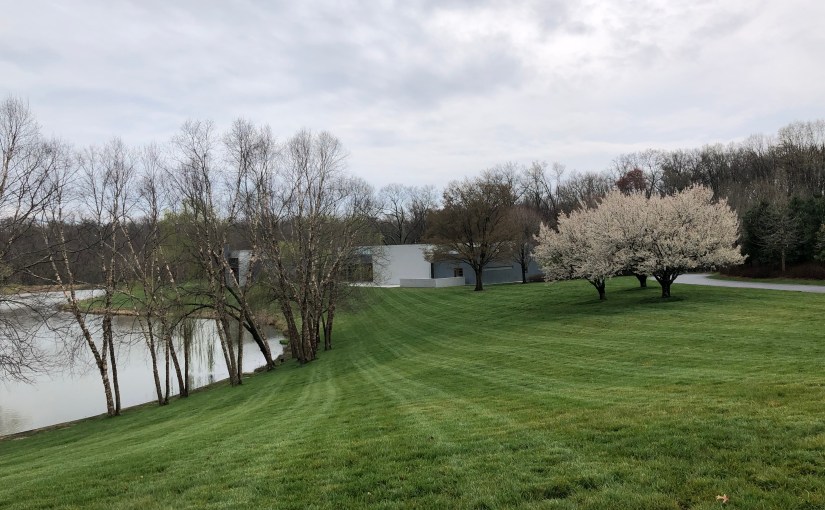
Come with me into the woods where spring is advancing, as it does, no matter what, not being singular or particular, but one of the forever gifts, and certainly visible.












 Eva K. Sullivan