Getting HS Seniors Across the Finish Line

Since 2009 I’ve been shepherding high school seniors out the front door in time to walk across the stage in a cap and gown at graduation. Sometimes they barely make it. The students who glide through 12th grade aren’t the ones whose stories linger. It’s the ones who barely make it, the immigrants who will make their families proud, who worked hard for a Maryland State Diploma. 

On Monday, Cee sat in my ELD Seminar class, uncharacteristically glum. 

“Miss!” (that’s how they address me) “I don’t think I can pass Modern World History. I don’t think I can graduate this year.” 

“Have you talked to the teacher? What assignments are missing? Who is your teacher? I will email them to find out.”

In a mixed class, where only a handful of seniors sit among sophomores and juniors, the teachers aren’t always aware of the urgency of grading an assignment that can make or break a senior’s chance to walk across the stage with the rest of their class. The teacher got back to me. Cee was passing the class with 64% D — enough to earn credit and be on track to graduate. Now all that remained was Credit Recovery for English 12A and English 12B, an online self-paced class. I emailed the teacher to ask about what he else needed to do. She unlocked the last Edmentum Unit Test so he could work on it during Seminar class. 

Eff skipped Seminar the last week of school. He works full time as a cook in a fancy local restaurant — he showed me pictures of his plating technique. Since he’d already passed every class, he was focused more on accruing extra hours at work to pay rent and utilities — a reality for many older immigrant students. Except he didn’t realize that he still needed 25 more Student Service Learning hours, a Maryland State graduation requirement. Another teacher and I scrambled to work with his counselor and administrator to get him the hours necessary.

Getting seniors across the finish line seems harder this year. Maybe because I’m at a new school with a different demographic than my previous school. It seems hard to believe they didn’t know about SSL hours, or how much work they needed to complete for a class, but when students are the first in their family to graduate from high school, you can’t assume they’re getting any help navigating the school system from Mom or Dad.


Other factors define the hardships faced by the class of 2025 — the English Multilingual Learners in my school, in my district, right now. And some of what I’ve seen is disturbing. 

In August 2024, the district changed how it evaluates international student transcripts. In a move that sounds equitable, but is deeply flawed, they began awarding credits to students from other countries who took English in their home country — without first determining a student’s level of language proficiency. In the past, international students were given a placement test to determine what classes to take. It sometimes meant that older students were put back a grade level so that they could acquire better English. Now those students are placed in mainstream content courses, like Math, Science, and Social Studies, without adequate language support. They struggle to keep up because their academic English skills are still developing.

As a result, this year, for the first time, we have newcomer students graduate with a high school diploma who can not read, write or speak English. And I’m worried that it’s only going to get worse. Dee is such a student. I got to know him second semester, when he’d already stopped coming to class. I called home, talked to his guardian, met to his counselor, emailed his administrator. He was completely discouraged because he could not understand what we were doing in class. So we made him a deal. If he finished the final Common Writing Task, we would give him a passing grade (60%) so he could earn credit and graduate.

English Multilingual Learners (we used to call them ESOL students, but that was deemed “deficit language” so we switched the acronym to EML) need explicit language instruction by a qualified teacher. They also benefit from smaller classes, where the teacher can guide them through an often-incomprehensible landscape of grades, credits, and SSL hours. They also need enough time to learn.

I wish we had more hours of instruction for these students. But for Cee, Eff, and Dee, a Maryland State Diploma is a meaningful achievement. For me, helping seniors cross the stage in their caps and gowns is one of the most rewarding jobs I have ever had.

Complex Trauma in High School English Class

While all around me the federal government is being dismembered, it seems apt to bring up the novel we’re reading.

In English 12 we’re halfway through Margaret Atwood’s The Handmaid’s Tale. It’s hard not to draw parallels to what is happening in the U.S.A. today. I feel like Offred seeing the bodies from the “salvaging” hanging on the wall for the crimes they committed — men killed for gender treachery, doctors for performing abortions.

U.S. AID was butchered yesterday. The Department of Education last week. NIH before that. Canada is now an enemy. Undocumented immigrants are all criminalized. In Gilead, they know that nobody can be trusted. They know how dangerous scientists and intellectuals can be. “Eyes” are everywhere.

My EML students worry that family members will be deported while they’re at school, parents afraid to go to the supermarket or church. They bring these fears into the classroom, and either act out or remain unusually quiet. Some students just stop coming to school. Their anxiety seeps into our shared space. Whispered conversations, a heartfelt journal entry.

A teacher friend from another school told me that a student asked if she was legal. She is from South America and speaks with a slight accent. She replied, “I am now, but I wasn’t when I first arrived in this country.” The student responded, “Then I would have reported you to ICE.”

It could be worse. I could be a 53-year-old NOAA scientist with kids about to go to college — decades into public service, too young to retire, years of exceptional performance reviews — fired through a social media posting from DOGE.

I could be an undocumented LGBTQ+ immigrant about to graduate.

Seniors had to write an essay about the value and relevance of The Handmaid’s Tale for today’s teens. One student wrote that reading this text shows the consequences of not standing up against injustices in the world today. Another student wrote, “our government is meant to protect us, but if they ever turn against us, marginalized communities will be in the most danger.”

The fascist flexing taking place right now in the White House is meant to provoke fear and panic. Our president is inflicting continuous trauma on this country, with marginalized populations suffering the most. And they are sitting in my English 12 class.

Teachers have little training in how to deal with anxiety, emotional dysregulation, or persistent difficulties in sustaining relationships (symptoms of complex stress disorder), but we see them becoming normalized.

Ordinary, said Aunt Lydia, is what you are used to. This may not seem ordinary to you now, but after a time it will. It will become ordinary.

I have hope that my students will stand up against injustices, that they will fight for the future they want to live in. I will do everything in my power to give them the tools they need to think critically about our world. One of the best tools at my disposal is excellent speculative fiction, like The Handmaid’s Tale.

Because I live in Montgomery County, Maryland, I can (still) teach a novel that has been banned in Florida, Oregon, and Texas. This is exactly what we need to be reading right now. This is exactly what we need to be discussing. This is exactly how we can overcome the psychological stress of living through the next four years.

The Upside Down

In just a week, the new presidential administration has sent a wave of fear and shock into every DC area school. I teach at a school that’s 60% Hispanic, with many undocumented students hidden in plain sight. When I quietly handed out MCPS fliers on immigrant rights, printed in Spanish and English, nearly every student grabbed one. 

My students don’t talk about it with me. It’s my first year at a new school, and all my classes are co-taught. So we haven’t developed the kind of mutual trust that I am used to by this time of year. But my colleague who works with newcomer students said they were panicking. 

Violent January 6 criminals are granted blanket pardons while innocent children, many of whom are refugees from political violence, are at risk of deportation. I keep coming back to my mantra from the previous Trump administration: “This is not who we are.” But clearly, I do not understand my fellow Americans. Apparently we are a bigoted, anti-authority, xenophobic country.

We’re living in an upside-down reality, like an episode of Stranger Things.

I will do everything in my power to help my students. But I wish I could change the channel.

Co-teaching: A Dance of Diplomacy

I first met Teacher S over Zoom the year my district went 95% virtual and leadership rolled out a new instructional model for ESOL students (back then, they were still called ESOL students, instead of the alphabet soup of acronyms we use today). Under the extreme circumstances of the pandemic, it was a pleasure to interact professionally with another teacher regularly. Mostly I followed along and did pull-out groups in the Breakout room, where I could provide additional language support. I enjoyed the camaraderie of having someone to help me figure out this totally new way of teaching.

Once back in the building, co-teaching took on a different tone. Instead of equal-size Zoom boxes, one of us now had a classroom and one of us didn’t. Teacher S filled the shelves with their books and knick-knacks, the walls with their colorful posters, and rugs and furniture brought in from their house. I had a shared desk in a shared office in the ESOL Department (now called the ELD office = English Language Development). 

Only one teacher’s name appeared on the electronic gradebook and the Canvas classroom tile. That teacher received all communication from parents, counselors, and the Main Office. I was lucky if they remembered to share pertinent information about students, new policies or schedule changes. I’d been erased.

All the ELD teachers were plugging in to the content teachers’ classes, no matter their level of experience, expertise, or comfort level. That first year, I had five different co-teachers. I had to lug my cart through the hallways, moving from room to room to room, struggling to get past clusters of students before the next bell rang. 

With each teacher, I had to negotiate the space – who would stand where, who would deliver the lessons, where would I put my things? With each teacher, I had to negotiate who would prepare which lessons, who would deliver the lessons, and who would grade the student work.  I had to tread carefully with each teacher, giving advance warning that I was an interrupter, and would that be okay? Sometimes I would need to paraphrase, repeat, or clarify information for ELD students. Sometimes I would need to modify handouts so the students learning English could understand what they were reading. Each interaction was a careful conversation. 

Today, that’s pretty much how co-teaching runs for secondary ELD teachers in MCPS. We’re thrown together with other teachers and it’s on us, the ELD teachers, to adapt to the content teacher’s style, their preferences, their classrooms. If we’re lucky, our ideas and teaching style mesh perfectly, and all the little decisions we make every day will help students thrive. If not, it’s a constant negotiation of every single interaction that takes place.

Diplomacy involves give and take – that I understand. But why does it always seem like the ELD specialist has to give something up? 

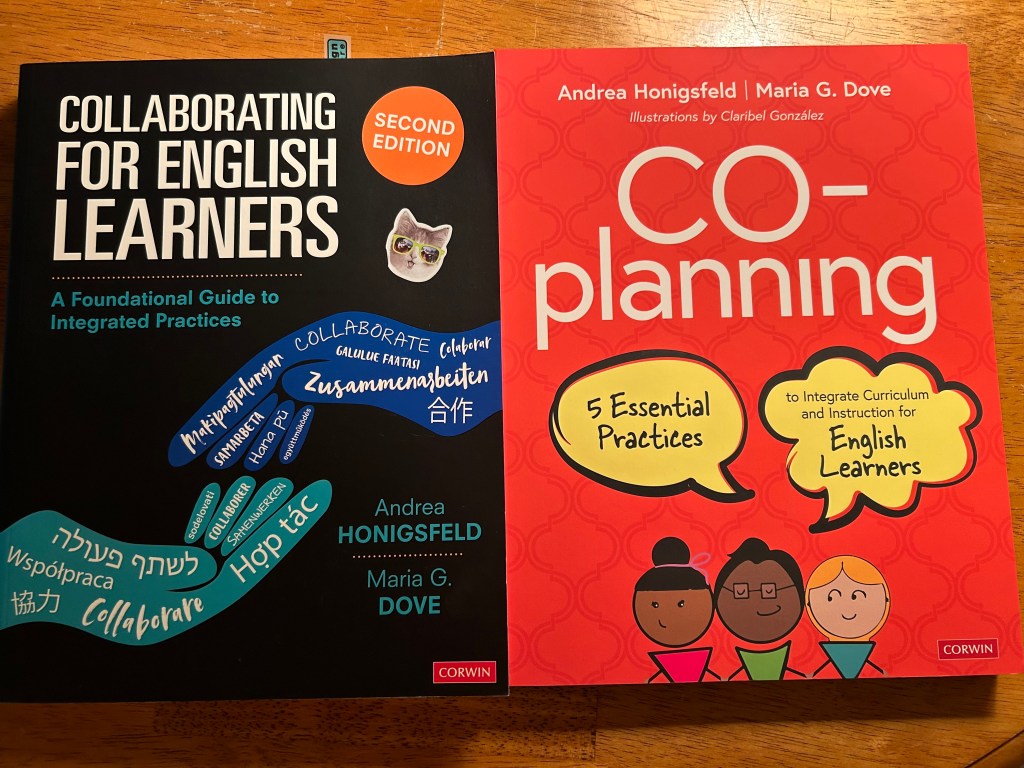
According to Collaborating for English Learners, by Andrea Honigsfeld and Maria G. Dove, teachers should “be on an equal footing” and all members of collaborative teams need “equal time to contribute to team efforts.” 

In their updated book, Co-Planning to Integrate Instruction for English Learners (2022), the same authors write “Co-planning requires teachers to change not only what they do but also how they think.” This is a critically important comment. “For co-planning to work, teachers must endeavor to share their beliefs, understandings, opinions, and convictions with fellow teachers and be open to incorporating unfamiliar ideas into their class instruction.”

It takes a certain type of professional to be flexible enough to incorporate unfamiliar ideas into their instruction. Most teachers are control freaks. Most teachers are used to being the lone voice of authority in front of children. Most are not willing to cede any territory without a fight. Or at least an exhausting series of conversations.

It’s only the third week of school, and I’ve been doing the dance of diplomacy since Pre-Service Week. I’m tired. I’ve lost my temper with my co-teachers; I’ve gotten on their nerves. I’ve succeeded in some important ways, and I’ve caved on others. 

Once the students enter the room, we smile and carry on. 

I have a dream

“It would be fatal for the nation to overlook the urgency of the moment.” MLK, 1963 speech

I have a dream that from my perch just 12 miles from the National Mall where Martin Luther King delivered his famous speech, my voice will make a difference. When I speak out, there’s always the possibility that I will be reprimanded or silenced like the four teachers in my school district placed on Administrative Leave for their social media posts this semester. I’m putting my dreams to the test this year.

While I am not vocal about my concerns for Palestinians, I speak up for English Language Learner students and for fellow teachers who support them. Sixty years since MLK urged fellow citizens to work together, we are still urging our leaders to work with us to preserve the dignity of our students. While Republicans in Iowa caucus for their party leader, they are vilifying immigrants who flee violence and persecution, hoping for a chance at the American Dream.

Fortunately, I work in a state that welcomes newcomers. I work in a district that supports English Language Learners. Yet, I speak out for conditions that need to be improved: curriculum that matches student needs, small-enough classes to support language learning, teacher workload that’s manageable, and more collaboration between administrators and teachers.

With the Blueprint for Maryland’s Future beginning to shape instruction across the state, now is the time to speak with school leaders and administrators. I am honored to be meeting with Interim State Superintendent, Dr. Carey M. Wright, as a member of Community WELL, a grassroots advocacy organization. We hope to open a dialogue that can help shape teaching and learning in the state of Maryland for years to come.

In addition, I am delighted to work with MCPS Curriculum and Instruction team to help provide differentiation options for EMLs in the Grade 10 English Language Arts curriculum material.

In the pit of my stomach, I’m nervous about speaking up. I’ve been invited into conversations at a higher level; I hope I represent my students and fellow teachers well. What if I say the wrong thing? What if they actually listen to me?

“We cannot walk alone.” (MLK, 1963)

Advocating for EML students

I just submitted my final Quarter 3 grades, and now Spring Break begins. What a relief to have no specific travel plans. I can finally recover from an ear infection and a bad case of bronchitis that I caught at school. Never in my 23 years of public school career have I missed so many days of instruction! It was quite a scramble to get caught up after seven days with different substitutes covering my classes. Now I can breathe free before carefully planning the home stretch.

This week I testified before the MCPS Board of Education, driving home the need for increased funding to support our English Multilingual Learners (EMLs), formerly known as ESOL students. The staffing allocations are frozen on January 1st, even though newcomers continue to arrive throughout the year. Teachers serving EML students are constantly working at a deficit.

At my school – which, by most standards, is a very good school – newcomers might be placed in a resource class, art, music, or double PE class because the mainstream classes have reached capacity. This may slow down or change their graduation trajectory. Students learning English need enough trained teachers who can meet their unique language needs.

While the English Language Development (ELD) teacher is not the only friendly face for our students, we are sometimes a lifeline for newcomer families who do not know how to navigate the American school system. The ELD teacher is often the only trusted adult they know.

When our class sizes increase, students do not get the individualized attention they need. Teachers of EMLs routinely take on extra duties well after the last bell rings for dismissal. We act as counselor, spokesperson, interpreter, and advocate. But when we are stretched too thin, students suffer the consequences.

When teachers are too burned out to go the extra mile, students become disengaged in school. When the demands on ELD teachers are too great, the school system fails the neediest students in our county. Simply put: we need increased funding to pay for vital programs. ELD departments around MCPS need a reduced student-to-teacher staffing ratio.

The Board of Education will soon be voting on how MCPS programs will be funded. EMLs are the fastest-growing population in the district. They deserve teachers and programs that meet their needs.

I will keep using my teacher voice to speak out for them.

Excuse me, now, I’m going to enjoy some cherry blossoms 🌸🌸🌸