In just a week, the new presidential administration has sent a wave of fear and shock into every DC area school. I teach at a school that’s 60% Hispanic, with many undocumented students hidden in plain sight. When I quietly handed out MCPS fliers on immigrant rights, printed in Spanish and English, nearly every student grabbed one.
My students don’t talk about it with me. It’s my first year at a new school, and all my classes are co-taught. So we haven’t developed the kind of mutual trust that I am used to by this time of year. But my colleague who works with newcomer students said they were panicking.
Violent January 6 criminals are granted blanket pardons while innocent children, many of whom are refugees from political violence, are at risk of deportation. I keep coming back to my mantra from the previous Trump administration: “This is not who we are.” But clearly, I do not understand my fellow Americans. Apparently we are a bigoted, anti-authority, xenophobic country.
We’re living in an upside-down reality, like an episode of Stranger Things.
I will do everything in my power to help my students. But I wish I could change the channel.
I first met Teacher S over Zoom the year my district went 95% virtual and leadership rolled out a new instructional model for ESOL students (back then, they were still called ESOL students, instead of the alphabet soup of acronyms we use today). Under the extreme circumstances of the pandemic, it was a pleasure to interact professionally with another teacher regularly. Mostly I followed along and did pull-out groups in the Breakout room, where I could provide additional language support. I enjoyed the camaraderie of having someone to help me figure out this totally new way of teaching.
Once back in the building, co-teaching took on a different tone. Instead of equal-size Zoom boxes, one of us now had a classroom and one of us didn’t. Teacher S filled the shelves with their books and knick-knacks, the walls with their colorful posters, and rugs and furniture brought in from their house. I had a shared desk in a shared office in the ESOL Department (now called the ELD office = English Language Development).
Only one teacher’s name appeared on the electronic gradebook and the Canvas classroom tile. That teacher received all communication from parents, counselors, and the Main Office. I was lucky if they remembered to share pertinent information about students, new policies or schedule changes. I’d been erased.
All the ELD teachers were plugging in to the content teachers’ classes, no matter their level of experience, expertise, or comfort level. That first year, I had five different co-teachers. I had to lug my cart through the hallways, moving from room to room to room, struggling to get past clusters of students before the next bell rang.
With each teacher, I had to negotiate the space – who would stand where, who would deliver the lessons, where would I put my things? With each teacher, I had to negotiate who would prepare which lessons, who would deliver the lessons, and who would grade the student work. I had to tread carefully with each teacher, giving advance warning that I was an interrupter, and would that be okay? Sometimes I would need to paraphrase, repeat, or clarify information for ELD students. Sometimes I would need to modify handouts so the students learning English could understand what they were reading. Each interaction was a careful conversation.
Today, that’s pretty much how co-teaching runs for secondary ELD teachers in MCPS. We’re thrown together with other teachers and it’s on us, the ELD teachers, to adapt to the content teacher’s style, their preferences, their classrooms. If we’re lucky, our ideas and teaching style mesh perfectly, and all the little decisions we make every day will help students thrive. If not, it’s a constant negotiation of every single interaction that takes place.
Diplomacy involves give and take – that I understand. But why does it always seem like the ELD specialist has to give something up?
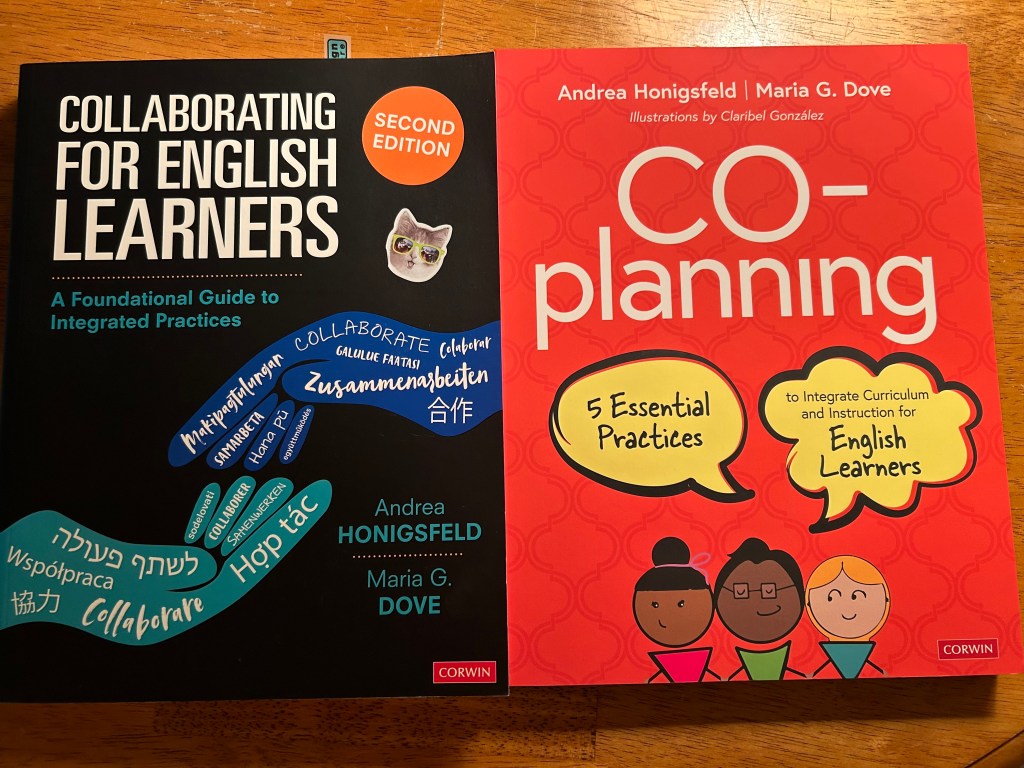
According to Collaborating for English Learners, by Andrea Honigsfeld and Maria G. Dove, teachers should “be on an equal footing” and all members of collaborative teams need “equal time to contribute to team efforts.”
In their updated book, Co-Planning to Integrate Instruction for English Learners (2022), the same authors write “Co-planning requires teachers to change not only what they do but also how they think.” This is a critically important comment. “For co-planning to work, teachers must endeavor to share their beliefs, understandings, opinions, and convictions with fellow teachers and be open to incorporating unfamiliar ideas into their class instruction.”
It takes a certain type of professional to be flexible enough to incorporate unfamiliar ideas into their instruction. Most teachers are control freaks. Most teachers are used to being the lone voice of authority in front of children. Most are not willing to cede any territory without a fight. Or at least an exhausting series of conversations.
It’s only the third week of school, and I’ve been doing the dance of diplomacy since Pre-Service Week. I’m tired. I’ve lost my temper with my co-teachers; I’ve gotten on their nerves. I’ve succeeded in some important ways, and I’ve caved on others.
Once the students enter the room, we smile and carry on.
I haven’t lost any family to COVID-19. My home was not ravaged by floods or blown apart by a hurricane. I did not have to escape a wildfire with just the clothes on my back. My school district has (mostly) listened to teachers and kept students home doing online instruction. I am fully employed. I feel grateful for good health and enough food to eat. But an unsettled feeling of restlessness, tension, and anxiety keeps me tossing and turning at night.
The combative tone set by the White House and uncertainty around the November 3 presidential elections permeate every daylight hour. Teachers are working harder than ever – learning new platforms, new apps, new instructional models, adjusting to new schedules, and adapting curriculum. We are juggling our own family responsibilities on top of four+ hours a day of mandated live Zoom meetings, each of which requires additional prep time. Yet we are being torn apart in the media for being “lazy” because we fought to do virtual-only learning until it is safe to go back into school buildings.
Where society is failing, teachers are getting it done. The Board of Education seems to think that regulating our every waking hour will justify our salaries. We are the professionals – we need to determine how our own time is spent. I can guarantee that teachers will put in extra hours to get the job done, no matter what the Board says. Schools are distributing meals, providing mental health counseling, and reaching out to families who need tech support. Schools provide a safe space and a community for the children we teach. Nobody knows better than classroom teachers how important it is to get kids back into the building. Online instruction is far from ideal, but it is better than putting a single life at risk due to COVID-19.
This year, for high school ESOL teachers in my district, there’s an added layer of complexity to our jobs. Instead of small, self-contained ESOL classrooms, we are now coteaching Honors English classes – we have no on-level English courses. My English Language Learners (ELLs) are now in classes with 29 students. Am I supposed to deliver ESOL services via Zoom chat while the regular teacher is talking? I’m struggling with this model. Coteaching is really hard. So much harder than teaching alone. It requires patience, diplomacy, careful dialogue, and mutual respect. I appreciate that my colleagues are so open-minded and hope that I am not stepping on their toes or pushing my ideas on them too much. It’s supposed to be a collaboration, but I feel marginalized. Just like my students.
All I want is for our leaders to recognize how hard it is to be a teacher right now. The students are showing up for class, ready and willing to learn. They need the structure and the opportunity to engage with peers. Even though I rarely see the students’ faces on Zoom or hear their voices, I know they are participating in this new way of doing school. When I lose sleep over the workload or the direction of the country, I remember the students. And I feel grateful for the best job in the world.


 Eva K. Sullivan