End-of-Season

The end of rowing season always brings feelings of relief and melancholy: so many days, so many hours of rowing, driving to the boathouse, planning workouts, carrying boats down to the dock, washing shells after practice, breaking down the motor launch, chatting at the park with others who share a love of the best sport in the world. I miss the exhaustion already, and don’t know how to fill my extra time.


I finished the Sunday crossword puzzle two weeks in a row, and I’ve learned a couple of new tunes on my recorder, ready to join the Celtic Ensemble again. I’m loving my new crime thriller audiobook (Louise Penny’s Inspector Gamache is so much fun). My son and I went shopping for winter coats together. We had Thanksgiving at a friend’s. My life is full. Yet I find myself researching winter workouts when I should be planning next week’s lessons for school.


I never thought I’d get pulled back into coaching teens again, but that’s exactly what’s happened. I love it and dread it at the same time. I love teaching new rowers the protocols and technique. I love watching young people get excited about doing hard physical work for the first time, especially when they thought they couldn’t. I love the playfulness they bring to the team, even when my reprimands about horseplay brought the wrath of parents.


It’s a rebuilding year with a small high school team. My job is to keep it fun, to teach the sport, and bring everyone back in the spring to start all over again. And bring a friend.


Seasonal transition periods usually make me more reflective, and this one is no different. Should I retire and become head coach again? For real? Should I finally downsize and move out of this large home? My older son recently got engaged. This would be a perfect grandmother house, if that’s in the future. I can put off that decision for now. I still have a rewarding, full-time teaching job. I believe I still make a difference.


Fellow masters rowers have started the Holiday Erg Challenge, a Concept 2 virtual rowing regatta, where the goal is to row 100K between Thanksgiving and Christmas. This is a regatta for people who don’t embrace the liminal space of transition like I do. They gather in the 28-degree dawn at the boathouse, ergs lined up in the darkness. They’re rowing 10K on the machines every day. I planned to join them, but sleeping in until sunrise and home-brewed coffee in my pajamas just called too loudly this year.


Tomorrow it’s December and we start the high school winter workouts three days a week. I’ve enjoyed my down time, but it’s time to embrace the crazy-busy again.

Mixed Masters 8+

Head of the Occoquan Regatta

Made you smile!

It’s the last day of Marking Period 1. English teachers are dressing as idioms for Halloween. I’m supposed to be a copy cat but I can’t find my kitty ears from last year. With a slight sore throat and headache, I have no energy to go digging through the family costume box before school. I’ll just wear a black mask and meow if anyone asks what I am today.

The everyday costumes that I see walking the halls of my extra large high school (2800 students) always put a smile on my face. Some girls with full, ready-for-my-close-up makeup at 7:45 am, carefully curated outfits with big fuzzy boots. Mostly a lot of hoodie sweatshirts and comfortable pants.

Teen backpacks also make me smile. Often adorned with labubus dangling from key chains, they feature little-kid cartoon characters: Lilo & Stitch, Lightning McQueen from Cars, Elsa from Frozen, Teenage Mutant Ninja Turtles. Worn without irony.

I don’t understand it. Six seven. Whatever. A reminder to just lighten up.

Make someone smile today.

(image generated by AI)

Dime qué hacer

A yellow sticky note is taped to the beige cinderblock wall near my desk. On it I’ve written the names of six online compliance trainings that I need to finish: WiDA Screener training (paper?), Level 1 Health Awareness, Level 1 Substance Abuse, Handle With Care, MCPS Test Security, PSAT Test Security. I cannot remember the deadlines for any of them, but I know I’m running out of time.

The PSAT training gave me a “test out” option, which I appreciated. But I failed. Now I have to take the entire online course. But I can’t remember which platform it’s on: Performance Matters? Canvas? Is it through PDO or do I access the program via a link buried in a slide inside an email? Who sent the email? What date? Who can I ask?

My school has pushed out the deadline for SLOs (Student Learning Objectives). I know it’s coming up soon, but I haven’t even talked about it once with my co-teachers. Since we’re teaching the same students, shouldn’t we be using the same template? Only because I happened to be in the office when my RT (Resource Teacher) walked through did I hear any guidance. She said that since the school focus was on the four language domains (Listening, Speaking, Reading, and Writing), that co-teachers should each focus on a domain. Glad to have a reminder of the school SIP. School Improvement Plan.

Last Monday, my RT held a department meeting and shared with all ELD teachers that we were going to complete the fall paperwork by ourselves this year and it’s due on October 1st. That’s 4.5 days to complete an onerous amount of paperwork that we had nothing to do with last year because their predecessor did most of the busywork herself. In fact, in my 25 years in MCPS, I’ve never had to print all the documents by myself.

Log into Synergy, find your students, upload the Parent Notification Letters. Print the PNLs, sign the PNLs, make three copies of each one. Give them to all your students, even if they’re getting the exact letter from another teacher in another class. Log the dates that you distributed the letters for parent signatures. Three times each. The photocopiers are never working. Wait. Synergy is down again. And my school-issued laptop won’t hold a charge. I have to leave school because my frustration level is peaking. A colleague walks in crying because of the pressure. I stay to comfort them.

Now the EL Plan, the English Language Plan, with official Accommodations for each student. There’s no list of students. We have to use our roster from Synergy to search for each student individually. Then click a bunch of drop-down menus with grade level, type of accommodations. Don’t forget to save! Then once it’s saved, you click on “Details” and actually check the boxes with accommodations. Open a new tab each time. This year we were advised to give bilingual dictionary accommodations only to Level 1 and Level 2 EML students. In the past everyone got this accommodation and extra time. Now I have to go back and check all the proficiency levels for all my students.

Do I have to complete a form for the No-Show students who are still on my roster?

I’m trying to focus on piloting a new curriculum in two of my ELD 3 Seminar classes, making slides, grading work in a timely manner, working with two new co-teachers who have never taught English 12, a new RT and five new colleagues all asking me what we’re supposed to be doing. We just finished Interims. But there’s not a moment to relax.

Several administrators from DELME Central Office will be visiting our school tomorrow, including the new Associate Superintendent for the Division of Multilingual Education, the DME division, pronounced “dee-may” like the Spanish word for “tell me.” The MCPS website can’t even keep up with all the acronym changes. ESOL, EML, ELD, SLIFE. Yet they expect me to keep up with all the paperwork, even when the deadline notification has probably violated my contract.

They want to see what’s going on in the classroom. But I want to talk to them about the ridiculous requirements for ELD teachers outside the classroom. I don’t want to be that teacher who always complains. But if I don’t speak up, who will?

DME. Dime! Tell me. What should I do?

Are ICEbreakers appropriate for EML students this year?

The school year has gotten off to a quiet start, against the most horrifying backdrop imaginable for immigrant students in the English Language  Development (ELD) program (formerly called ESOL). Images on the news show ICE agents throwing black and brown men to the ground and leading them away in handcuffs, disappearing them to unknown destinations, where due process is almost nonexistent. Law-abiding residents just going to work. The families and neighbors of my students targeted by armed men in masks.

I teach at one of the largest high schools in the state of Maryland, with a student population that’s 60% Hispanic, and about 25% actively enrolled in our ELD program. After sitting through a week of Pre-Service teacher meetings where not a single mention of immigration was made, I sent an email message to my supervisor pointing out my concerns that students might face unusually high levels of anxiety and fear as they come back to school this year. And maybe we could send an email to the entire staff. And share the robust MCPS web page for Immigrant Supports

I even mentioned that the typical classroom ICEbreakers might be triggering for some students.

Instead of support, I got called in to my supervisor’s office and reprimanded for sending out a “political” message using school email. Apparently now it’s “political” to express concern for EML students.

Is it that my supervisors are low-key MAGA enthusiasts? Are they afraid? Do they just not want to be inconvenienced? Why would someone in charge of a program comprising 100% immigrant students not be on the side of our students? Of their teachers and staff? (as an aside, one of my colleagues, whose spouse was born overseas, says he takes his U.S. passport with him to take out the trash so that he won’t be arrested). We are living in an era where our government is turning against us.

I am deeply distressed that school leaders have ignored my concerns and are trying to pretend that everything is normal. Even worse, they told me, “You need to be careful. I don’t want you to get in trouble” WTF?! I was pointing out that we need to be aware of pressures our students were facing outside of school that could affect attendance, participation in school events, grades, and social-emotional well-being. Isn’t that important any more?

If this what the school year will look like for 2025-2026, then I’m not sure how I’ll make it through. I will follow school rules and be compliant at work, but outside of the duty day, I will use my teacher voice to exercise my First Amendment rights while I still have them, to speak out in support of immigrants, the people who actually keep our country running.

Even though the Department of Education has quietly rescinded the federal guidelines for students learning English, I will support my students, whatever their immigration status, for as long as I am able. Which may not be very long, at this rate.

Through a confidential source, I learned that the MCPS International Office usually admits close to 1,000 newcomer students every year. Last year, they admitted 850. This year, only 12.

I hope I’ll make it another year. Or at least until a time when choosing the right ICEbreaker activity is my biggest back-to-school concern.

Making my bed

You’ve made your bed; now lie in it. ~ Anonymous

Early to bed, early to rise, makes a man healthy, wealthy, and wise. ~Benjamin Franklin

If you want to change the world, start off by making your bed. ~ Admiral McRaven

*~*~*~*

Most people my age have plenty of experience buying new furniture, but for me it’s a remarkable feat. For years – make that decades – most of my household furnishing were either my husband’s property (from his bachelor days) or hand-me-downs. He owned some nice pieces and cared more about making our home beautiful than I did.

That’s why when we separated a few years ago, he took most of the furniture with him.

I’ve slowly been filling in the empty spaces of my house. Curb-alerts from the neighborhood list serve are a favorite. My couch, coffee table, side tables, living room rug, side chairs, lamps, and kitchen table were all offered at a very low price or free. I’ve cleaned, re-upholstered, or covered many items; now they’re all mine.

Some people think it’s weird to buy used furniture, but it gives me great pleasure that every single piece has a little story.

That’s why, when I bought a new bed recently, I felt like a kid going off to college for the first time. It felt momentous. It felt like a real transition. A new bed represents something. An indulgence. A necessity. A new beginning.

I’d been sleeping on my son’s old bunk bed mattress since before my separation. It was past time for a change.

My horoscope this month says that I’m entering a two-year period where I’ll turn inward in a rare introspective phase and lay the foundations for what’s to come. What does it mean? I’m not sure. But I’m getting a good night’s sleep night after night after night. And it feels really good.

ELD Teachers: Still the illegitimate step-children of the district

Twenty five years ago I started my MCPS career teaching in a stairwell. As the newbie, I was content to pull kids into a quiet, sunny space, even though I felt a little unwanted, like Harry Potter. The specialized small-group instruction allowed them to feel more comfortable practicing English and taking academic risks than gathered than in a large room with 24 others.

Then the fire marshal came along and shut me down.

Since 2000, I have taught elementary, middle and high school classes – all levels of ESOL (before they were called ELD), Developmental Reading, Basic Reading, READ 180, Academic Acceleration, and SLIFE. I’ve co-taught Physics, Basic Math, and English 6, 9, 10, 11, and 12. I’ve taught alone in my own classroom or in a shared space. I’ve pulled kids out of the classroom and I’ve plugged into the classroom.

As I changed schools, grade levels, and instructional models, one thing has become clear: ELD teachers are expected to teach just about any subject at every grade level, and to remain completely flexible and fluid. Most teachers grumble when they have to learn a new curriculum or when the district launches a new state test. But ESOL teachers have had to endure an onslaught of changes to their profession year after year after year.

The changing acronyms and language around our field may be the best example of dramatic shifts. The field of ESOL became ELD, while the students are EMLs (Emergent Multilingual Learners), and the classes they take are ELP courses. I have no idea what that stands for. Our district office is called DELME. Whatever.

Just to keep us on our toes, the district DELME Office keeps purchasing new curriculum resources, each requiring many hours of extra teacher prep time to use effectively. We’ve gone from an internally-written (and in my opinion, excellent) curriculum guide to boxed sets: Rigor, System 44, READ 180, Study Sync, CKLA and more. Let’s not forget the grossly inappropriate frog reader books purchased for our high school METS/ SLIFE students in 2018 that were mostly warehoused before they even saw a classroom.

Around the county, our ELD book rooms are full of discarded materials that probably cost the district hundreds of thousands of dollars and cost the teachers hundreds of hours of prep time.

Recently, MCPS moved to a co-teaching model of instruction for secondary students (see my September 2024 blog https://wp.me/p6YtYW-BR). It’s also a new instructional model that takes time for teachers to learn. Instead of ELD classes at different proficiency levels focusing on specific language objectives, now all but the newcomers are mainstreamed into math, science, and social studies classes — often with no curriculum to support language learning. This can be good for some students, especially those who are fully literate in their own languages. But students at lower levels of proficiency risk being left behind.

It is the burden of the co-teacher to develop lessons that support these ELD students in addition to negotiating for time and space to deliver those lessons.

I would like to work with our struggling students in small groups, but I have only the noisy hallway for pull-out instruction. I have no classroom, except the space I share with my co-teachers during our 50 minutes together.

During my contractual planning periods, I sit at a shared desk in a cramped office where there’s no place to hang my coat. Staff come and go to use the refrigerator, the microwave, or just to chat. Sometimes I’m happy for the camaraderie, but mostly it’s hard to get any work done. There’s no place to make a personal phone call during the school day or to have a private meeting with a colleague. There’s no quiet space to decompress after a morning dancing diplomatically around another teacher.

My working conditions have come full circle in 25 years.

We’ve just hired three new ELD teachers for next school year, and I’m already anxious about where they’ll sit. Our department is suddenly bigger than the English Department and yet we have half the working space they do.

That stairwell from 25 years ago is looking like a really attractive option.


Getting HS Seniors Across the Finish Line

Since 2009 I’ve been shepherding high school seniors out the front door in time to walk across the stage in a cap and gown at graduation. Sometimes they barely make it. The students who glide through 12th grade aren’t the ones whose stories linger. It’s the ones who barely make it, the immigrants who will make their families proud, who worked hard for a Maryland State Diploma. 

On Monday, Cee sat in my ELD Seminar class, uncharacteristically glum. 

“Miss!” (that’s how they address me) “I don’t think I can pass Modern World History. I don’t think I can graduate this year.” 

“Have you talked to the teacher? What assignments are missing? Who is your teacher? I will email them to find out.”

In a mixed class, where only a handful of seniors sit among sophomores and juniors, the teachers aren’t always aware of the urgency of grading an assignment that can make or break a senior’s chance to walk across the stage with the rest of their class. The teacher got back to me. Cee was passing the class with 64% D — enough to earn credit and be on track to graduate. Now all that remained was Credit Recovery for English 12A and English 12B, an online self-paced class. I emailed the teacher to ask about what he else needed to do. She unlocked the last Edmentum Unit Test so he could work on it during Seminar class. 

Eff skipped Seminar the last week of school. He works full time as a cook in a fancy local restaurant — he showed me pictures of his plating technique. Since he’d already passed every class, he was focused more on accruing extra hours at work to pay rent and utilities — a reality for many older immigrant students. Except he didn’t realize that he still needed 25 more Student Service Learning hours, a Maryland State graduation requirement. Another teacher and I scrambled to work with his counselor and administrator to get him the hours necessary.

Getting seniors across the finish line seems harder this year. Maybe because I’m at a new school with a different demographic than my previous school. It seems hard to believe they didn’t know about SSL hours, or how much work they needed to complete for a class, but when students are the first in their family to graduate from high school, you can’t assume they’re getting any help navigating the school system from Mom or Dad.


Other factors define the hardships faced by the class of 2025 — the English Multilingual Learners in my school, in my district, right now. And some of what I’ve seen is disturbing. 

In August 2024, the district changed how it evaluates international student transcripts. In a move that sounds equitable, but is deeply flawed, they began awarding credits to students from other countries who took English in their home country — without first determining a student’s level of language proficiency. In the past, international students were given a placement test to determine what classes to take. It sometimes meant that older students were put back a grade level so that they could acquire better English. Now those students are placed in mainstream content courses, like Math, Science, and Social Studies, without adequate language support. They struggle to keep up because their academic English skills are still developing.

As a result, this year, for the first time, we have newcomer students graduate with a high school diploma who can not read, write or speak English. And I’m worried that it’s only going to get worse. Dee is such a student. I got to know him second semester, when he’d already stopped coming to class. I called home, talked to his guardian, met to his counselor, emailed his administrator. He was completely discouraged because he could not understand what we were doing in class. So we made him a deal. If he finished the final Common Writing Task, we would give him a passing grade (60%) so he could earn credit and graduate.

English Multilingual Learners (we used to call them ESOL students, but that was deemed “deficit language” so we switched the acronym to EML) need explicit language instruction by a qualified teacher. They also benefit from smaller classes, where the teacher can guide them through an often-incomprehensible landscape of grades, credits, and SSL hours. They also need enough time to learn.

I wish we had more hours of instruction for these students. But for Cee, Eff, and Dee, a Maryland State Diploma is a meaningful achievement. For me, helping seniors cross the stage in their caps and gowns is one of the most rewarding jobs I have ever had.

The Power of Singing Together

100 days of the Mad King and we’re all trying to cope with the chaos, fear, and profound sense of loss. How many times can we shake our heads at the absurdity of this moment in US history?

The democratic system of checks and balances may not survive this administration. Like many Americans, I sat in stunned silence for a couple of weeks after Inauguration Day, as executive orders started to tear down the institutions that make our country great.

Then people organized. Rallies, protests, Tesla take-downs. Letter-writing campaigns. Phone banking. Grass roots movements that start with like-minded neighbors, groups, and communities.

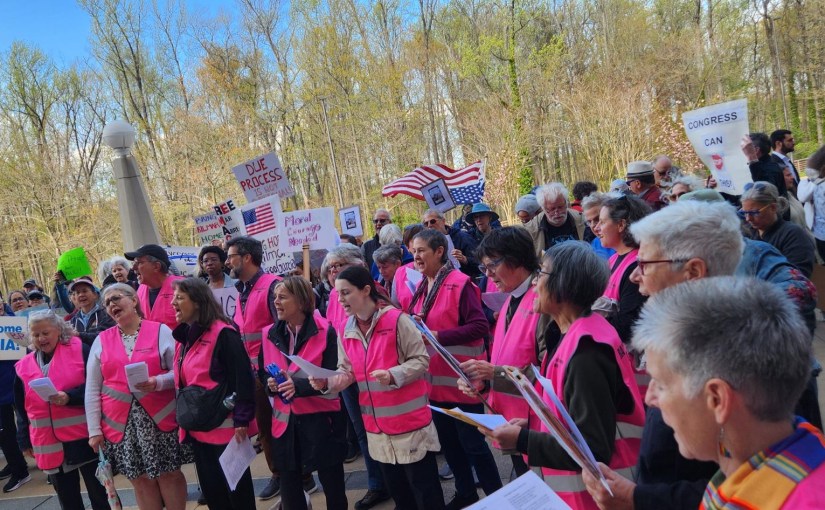
I found my people in a choir. It’s not a church choir, even though we sometimes meet in a church. It’s less than three months old, but we’ve already made it to 11 rallies, marches, and protests — some of them organized super last minute. We sing songs of inspiration and protest. We take old, familiar tunes and change the lyrics to suit the times. Or we sing old protest music from the 1960s. We bring tambourines, drums, shakers. We bring our voices and our shared passion.

Bystanders have approached us after every event and said how much they appreciate the power of singing together. Our choir does not perform in the traditional sense, but we help the crowd focus and unify. Rallies with group singing reinforce the emotional connection among strangers. We desperately need to feel connected right now.

The health benefits of group singing have long been studied. According to an Oxford University article, singing together in a group improves breathing, posture, and muscle tension. Choral singing enhances our sense of belonging and happiness through the release of neurochemicals.

Others pour their creativity into making amazing protest signs and banners, or grabbing a megaphone and shouting slogans. Singing in a group is how I plan to save my sanity. The thing is: you don’t even have to be a good singer to join this kind of singing group. All voices are valued. Together we fight the daily assaults inflicted by our own federal government.

If it’s Thursday, it must be community singalong time. I highly recommend it!

Complex Trauma in High School English Class

While all around me the federal government is being dismembered, it seems apt to bring up the novel we’re reading.

In English 12 we’re halfway through Margaret Atwood’s The Handmaid’s Tale. It’s hard not to draw parallels to what is happening in the U.S.A. today. I feel like Offred seeing the bodies from the “salvaging” hanging on the wall for the crimes they committed — men killed for gender treachery, doctors for performing abortions.

U.S. AID was butchered yesterday. The Department of Education last week. NIH before that. Canada is now an enemy. Undocumented immigrants are all criminalized. In Gilead, they know that nobody can be trusted. They know how dangerous scientists and intellectuals can be. “Eyes” are everywhere.

My EML students worry that family members will be deported while they’re at school, parents afraid to go to the supermarket or church. They bring these fears into the classroom, and either act out or remain unusually quiet. Some students just stop coming to school. Their anxiety seeps into our shared space. Whispered conversations, a heartfelt journal entry.

A teacher friend from another school told me that a student asked if she was legal. She is from South America and speaks with a slight accent. She replied, “I am now, but I wasn’t when I first arrived in this country.” The student responded, “Then I would have reported you to ICE.”

It could be worse. I could be a 53-year-old NOAA scientist with kids about to go to college — decades into public service, too young to retire, years of exceptional performance reviews — fired through a social media posting from DOGE.

I could be an undocumented LGBTQ+ immigrant about to graduate.

Seniors had to write an essay about the value and relevance of The Handmaid’s Tale for today’s teens. One student wrote that reading this text shows the consequences of not standing up against injustices in the world today. Another student wrote, “our government is meant to protect us, but if they ever turn against us, marginalized communities will be in the most danger.”

The fascist flexing taking place right now in the White House is meant to provoke fear and panic. Our president is inflicting continuous trauma on this country, with marginalized populations suffering the most. And they are sitting in my English 12 class.

Teachers have little training in how to deal with anxiety, emotional dysregulation, or persistent difficulties in sustaining relationships (symptoms of complex stress disorder), but we see them becoming normalized.

Ordinary, said Aunt Lydia, is what you are used to. This may not seem ordinary to you now, but after a time it will. It will become ordinary.

I have hope that my students will stand up against injustices, that they will fight for the future they want to live in. I will do everything in my power to give them the tools they need to think critically about our world. One of the best tools at my disposal is excellent speculative fiction, like The Handmaid’s Tale.

Because I live in Montgomery County, Maryland, I can (still) teach a novel that has been banned in Florida, Oregon, and Texas. This is exactly what we need to be reading right now. This is exactly what we need to be discussing. This is exactly how we can overcome the psychological stress of living through the next four years.

The Upside Down

In just a week, the new presidential administration has sent a wave of fear and shock into every DC area school. I teach at a school that’s 60% Hispanic, with many undocumented students hidden in plain sight. When I quietly handed out MCPS fliers on immigrant rights, printed in Spanish and English, nearly every student grabbed one. 

My students don’t talk about it with me. It’s my first year at a new school, and all my classes are co-taught. So we haven’t developed the kind of mutual trust that I am used to by this time of year. But my colleague who works with newcomer students said they were panicking. 

Violent January 6 criminals are granted blanket pardons while innocent children, many of whom are refugees from political violence, are at risk of deportation. I keep coming back to my mantra from the previous Trump administration: “This is not who we are.” But clearly, I do not understand my fellow Americans. Apparently we are a bigoted, anti-authority, xenophobic country.

We’re living in an upside-down reality, like an episode of Stranger Things.

I will do everything in my power to help my students. But I wish I could change the channel.